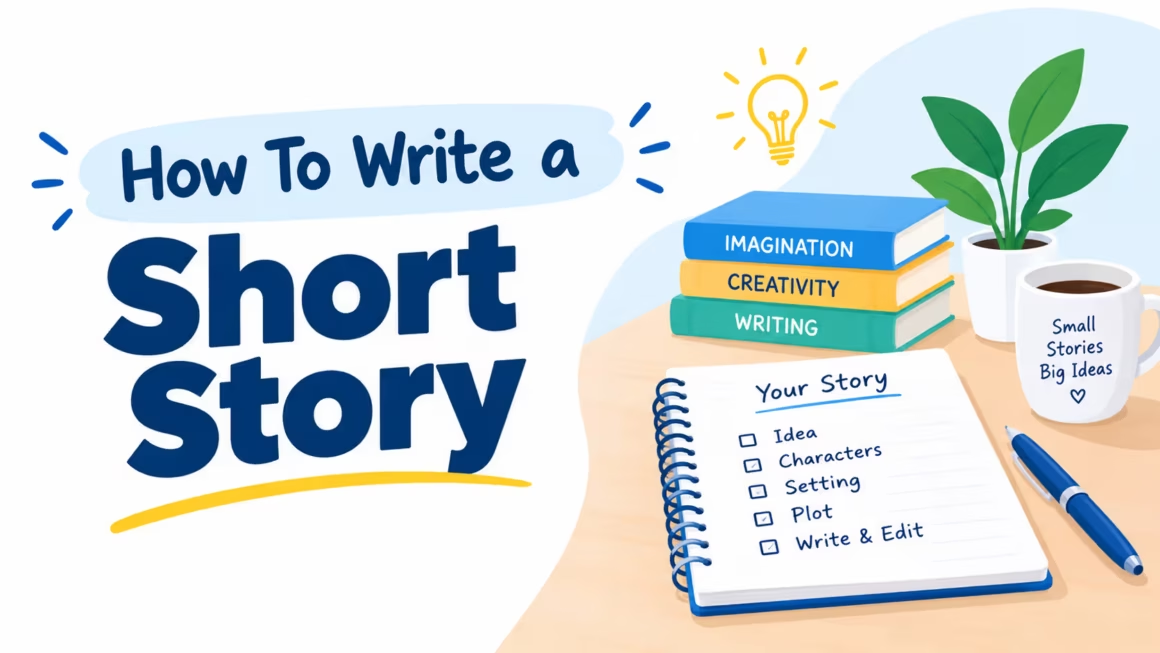
Writing a short story may seem difficult at first. Where should you begin? How do you create interesting characters? And, most importantly, how do you end your story without confusing the reader?
Don’t worry! You don’t need complicated language or years of writing experience to get started.
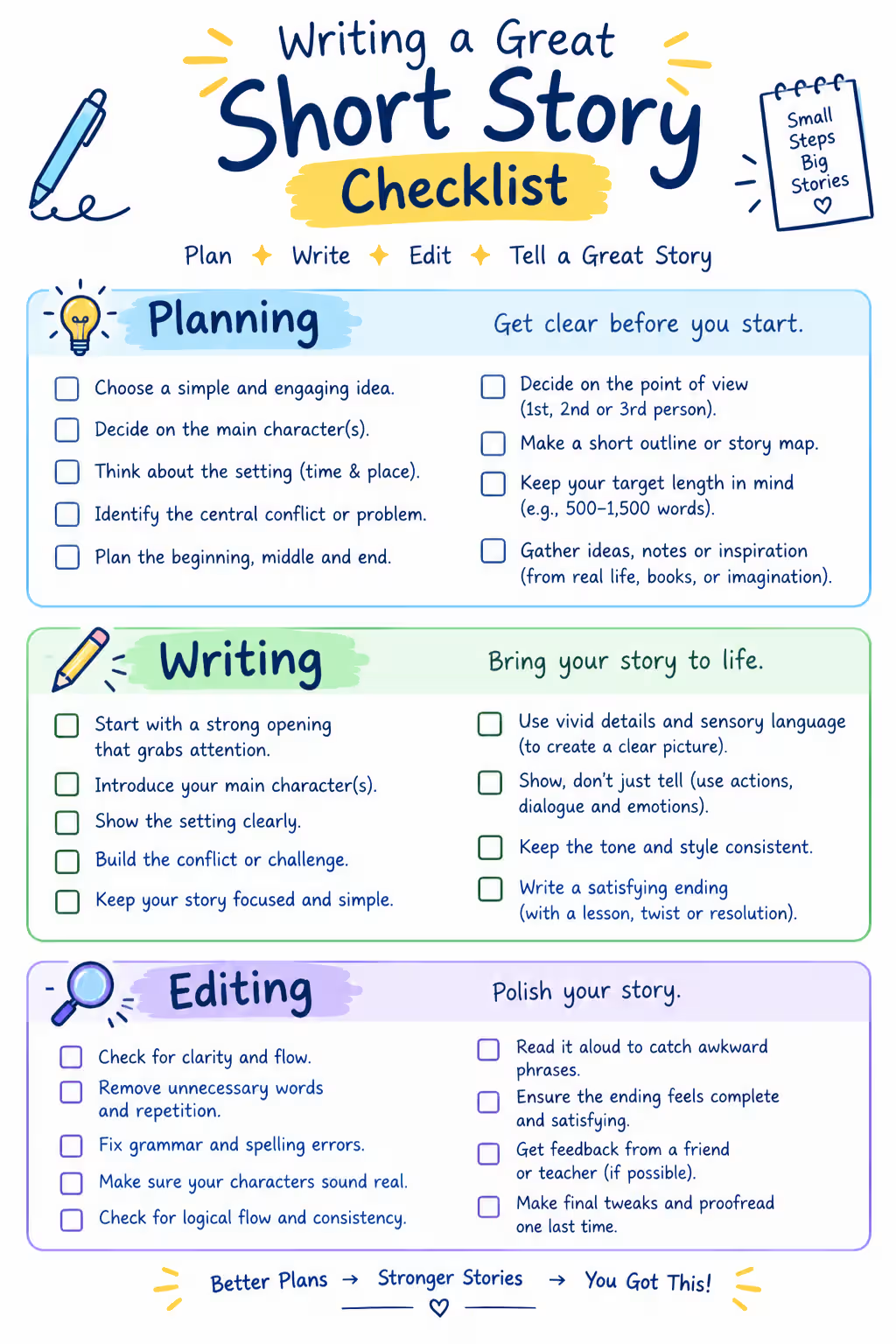
To write a short story, choose one interesting idea, create a main character, give that character a problem, and explain what happens next. Organize the events into a beginning, middle, and ending. Finally, revise your writing to make every scene clear and meaningful.
In this guide, you’ll learn how to write a short story step by step, with an example and a practical checklist.
What Is a Short Story?
A short story is a brief work of fiction that tells a complete story in a limited number of words. It usually focuses on one main event, problem, or experience.
Unlike a novel, a short story doesn’t need several characters, complicated events, or a long introduction.
Most traditional short stories contain five important elements:
- Character: Who is the story about?
- Setting: Where and when does it happen?
- Plot: What happens in the story?
- Conflict: What problem does the character face?
- Resolution: How does the situation end?
Short stories can be funny, emotional, mysterious, exciting, or educational. The important thing is that the reader understands what happens and why it matters.
How to Write a Short Story in 8 Steps
You don’t need to plan every single sentence before writing. However, following these eight steps can make your work much easier.
1. Choose One Interesting Idea
Every story begins with an idea! And that idea doesn’t need to be extraordinary.
You can find inspiration in a conversation, a childhood memory, an unexpected event, or something you notice while travelling.
Try asking yourself, “What if something unusual happened today?”
For example: What if a student found something important just as the last school bus was leaving?
That’s a simple idea, but it offers a problem, a possible decision, and an opportunity for an interesting ending.
2. Create Your Main Character
Next, decide who will experience the events.
Give your main character a name, a goal, and a reason to care about that goal. Your character might want to win a competition, find a missing object, help a friend, or overcome a fear.
For example:
Meet Tara, a student who wants to catch the school bus and reach home on time.
You don’t need to describe Tara’s entire life. Just introduce the details that matter to the story.
3. Introduce a Problem or Conflict
A story becomes interesting when something stands between the character and what they want.
The problem could be an argument, a difficult choice, a mistake, or an unexpected situation.
For Tara, imagine this: Her younger brother’s drawing has fallen into a puddle. The school bus is about to leave!
Now she must choose between catching the bus and saving the drawing.
Notice how one small problem immediately creates a reason to keep reading.
4. Plan the Beginning, Middle, and Ending
Before drafting, write a simple outline. Three or four sentences are enough.
- Beginning: Introduce Tara and the school bus.
- Middle: Tara notices the drawing in the puddle.
- Turning point: She decides to save it and misses the bus.
- Ending: The drawing becomes a special family memory.
This outline provides direction without limiting your creativity. You can change the details while writing.
5. Write an Opening That Creates Curiosity
Your first sentence should give readers a reason to continue.
Compare these openings:
Weak: Tara was a student. She went to school every day.
Better: The school bus was leaving when Tara spotted her brother’s drawing in a puddle.
The second opening immediately introduces a situation that needs attention.
Try starting with an action, a surprising moment, an important decision, or a line of dialogue.
6. Build the Story With Clear Actions and Details
Now describe what your character does, feels, and decides.
Instead of writing, “Tara was worried,” you could write, “Tara looked at the bus, then at the drawing, and ran towards the puddle.”
This lets readers understand her feelings through her actions.
Include useful descriptions, but avoid explaining every small movement. Choose details that help readers imagine the scene or understand the character.
7. Create a Meaningful Ending
A good ending doesn’t always need a happy result or a surprising twist.
However, it should show what happened because of the character’s actions.
Perhaps Tara misses the bus but saves the drawing. Later, the family finds a creative way to repair it.
The important thing is to connect the ending to the problem introduced earlier.
You can also end with a small change in the character’s thinking, feelings, or relationship.
8. Edit and Proofread Your Story
Once you’ve finished your first draft, read it again. Don’t focus only on spelling mistakes!
First, check whether the events make sense. Then improve unclear sentences and remove unnecessary details.
Finally, check your grammar, punctuation, dialogue, and spelling.
One helpful trick? Read the story aloud. If a sentence feels confusing or difficult to say, it may need rewriting.
Short Story Structure at a Glance
Here’s a simple structure you can use whenever you’re preparing a new story.
| Story part | What to include |
|---|---|
| Beginning | Main character, setting, and goal |
| Middle | Problem and important actions |
| Turning point | A difficult choice or key event |
| Ending | Result, change, or realization |
Remember, this structure is a helpful starting point, not a strict rule. Some excellent short stories use unusual structures or leave certain questions unanswered.
A Short Story Writing Example
Let’s turn our earlier idea into a short story.
The Drawing in the Rain
At 4:55 p.m., Tara saw her younger brother’s drawing lying in a puddle outside the school.
He had spent a whole week making it for their mother’s birthday.
The school bus was already leaving. Tara looked at the drawing, then at the bus.
Without thinking twice, she ran towards the puddle.
She picked up the paper, wiped away the mud, and rushed towards the road. But the bus was gone.
An hour later, Tara reached home with wet shoes and a dirty drawing.
“It’s ruined!” her brother whispered.
Tara brought him a box of coloured pencils.
“Then let’s make it beautiful again,” she said.
Together, they painted a bright yellow sun over the muddy corner.
That evening, their mother placed the drawing on the refrigerator. She smiled, looking at the colourful sun.
Tara smiled too. Missing the bus suddenly didn’t seem so terrible.
Why does this example work?
It has a clear main character, an immediate problem, a meaningful decision, and a result. The ending also connects directly to the drawing introduced at the beginning.
You can explore more storytelling ideas by reading short stories with moral lessons for students.
Complete Short Story Writing Checklist
Before you finish, use this checklist to review your own writing.
Planning Checklist
- I have chosen one clear story idea.
- My main character has a goal.
- I know where and when the story happens.
- There is a problem or conflict.
- I have planned a possible ending.
Writing Checklist
- My opening creates interest.
- The events follow a clear sequence.
- My character makes meaningful decisions.
- I have included relevant actions and details.
- The ending connects to the main problem.
Editing Checklist
- Every important scene contributes to the story.
- I have removed unnecessary repetition.
- My sentences are easy to understand.
- Dialogue and punctuation are correct.
- I have checked spelling and grammar.
- I have read my story aloud at least once.
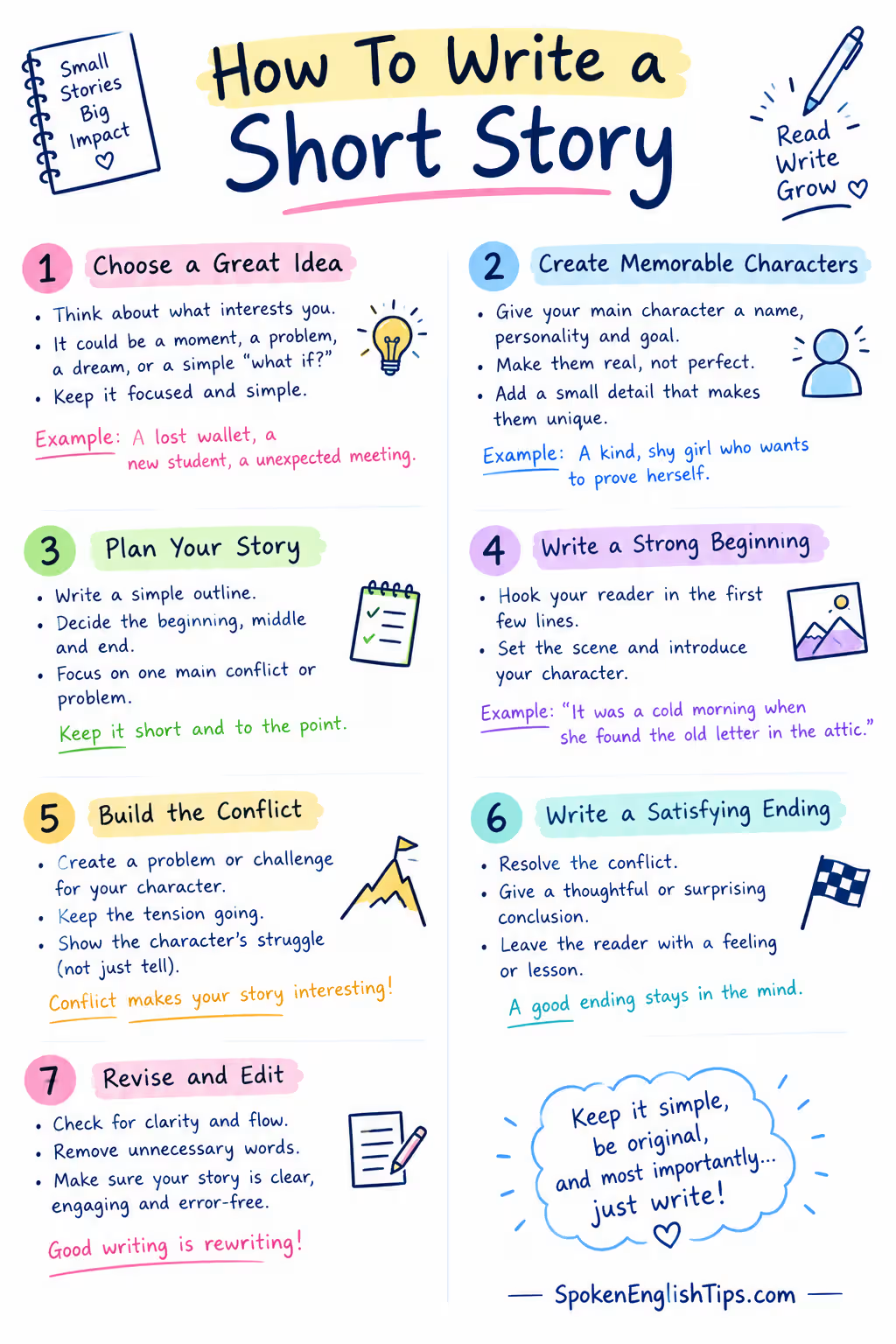
You don’t have to follow every item perfectly. Use the checklist to identify what works and what needs more attention.
Common Mistakes to Avoid
Even a good idea can become confusing if the writing isn’t organized. Here are a few common problems.
Too many characters: Introduce only the people who are important to the main story. A smaller cast is usually easier for beginners to manage.
A slow introduction: Don’t spend several paragraphs explaining things readers don’t need to know. Begin near an interesting event.
No clear problem: If nothing challenges the character, the story may feel incomplete. Add a goal, obstacle, or meaningful choice.
Too much description: Describe what matters. Readers don’t need every detail about a room, street, or person’s appearance.
A rushed ending: Avoid introducing an unrelated solution at the last moment. Let the ending grow naturally from earlier events.
Final Thoughts
Learning how to write a short story becomes easier with practice. Start with one idea, introduce a character, create a meaningful problem, and follow it towards an ending.
Your first draft doesn’t need to be perfect. Give yourself permission to experiment, make changes, and discover what works.
Most importantly, finish the story you started! Once you have a complete draft, you’ll have something real to improve.