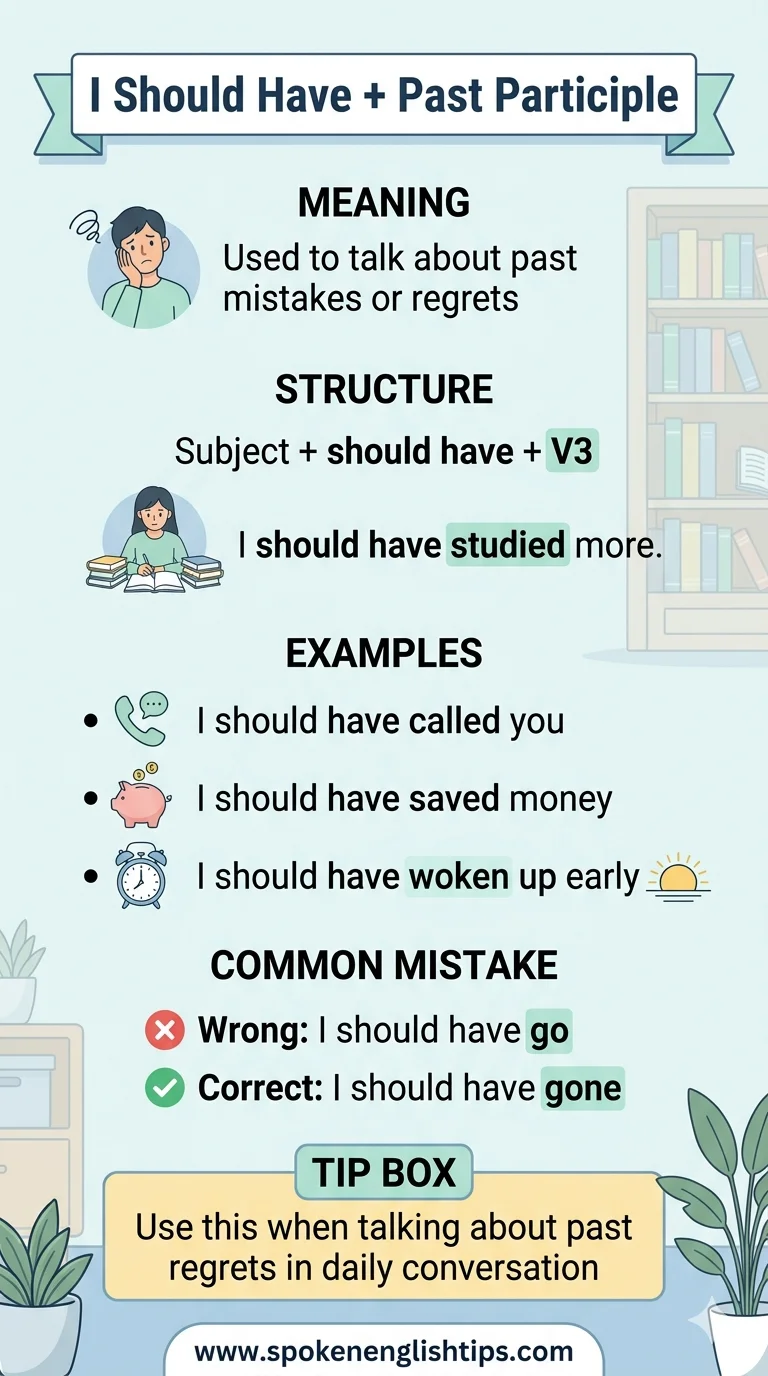
“I should have + past participle” is used when we talk about past mistakes or regrets. It means something was the right thing to do, but we did not do it. We often use this structure in daily conversations when we think about what we did wrong or what we could do better. For example, if you missed a meeting, you may say, “I should have attended the meeting.” It helps express feelings like regret, guilt, or learning from past actions. This structure is very common in spoken English, especially when sharing experiences or giving advice.
◎ Important Points
- Used to talk about past mistakes or regrets
- Shows something was a good idea, but not done
- Always followed by the past participle (V3 form)
- Common in daily conversations
- Often used with “I”, “You”, “We”, “They”
- Expresses learning from past actions
➤Key Concept
✅ Sentence Structure: Subject + should have + past participle (V3)
Example: I should have studied harder.
This structure is used to talk about something you did not do in the past but now feel was the right choice.
Tip: Use this form when sharing personal experiences to sound more natural in conversations.
➤ Common Mistakes To Avoid
| Common Mistake | Wrong Example | Correct Example |
|---|---|---|
| Using base verb instead of V3 | I should have go early | I should have gone early |
| Using present tense | I should have go to office | I should have gone to office |
| Missing “have” | I should studied more | I should have studied more |
| Using “had” instead of “have” | I should had called him | I should have called him |
| Using for future situations | I should have go tomorrow | I should go tomorrow |
➤ Examples
- I should have woken up earlier today.
- I should have called you last night.
- I should have saved more money.
- I should have listened to my parents.
- I should have taken that job offer.
- I should have booked the tickets earlier.
- I should have checked my email.
- I should have finished my work on time.
- I should have brought my umbrella.
- I should have asked for help.
➤ Practice Examples
Fill in the blanks
- I should have ______ (finish) my homework.
- She should have ______ (call) me earlier.
- We should have ______ (leave) on time.
- He should have ______ (study) for the exam.
- They should have ______ (inform) us.
Change incorrect sentence to correct one
- I should have go there.
- She should have eat breakfast.
- We should have take a taxi.
- He should have do his work.
- They should have come late.
Speak this sentence aloud
- I should have completed my work earlier.
- I should have made a better decision.
- I should have practiced English daily.
- I should have listened carefully.
- I should have planned my day properly.