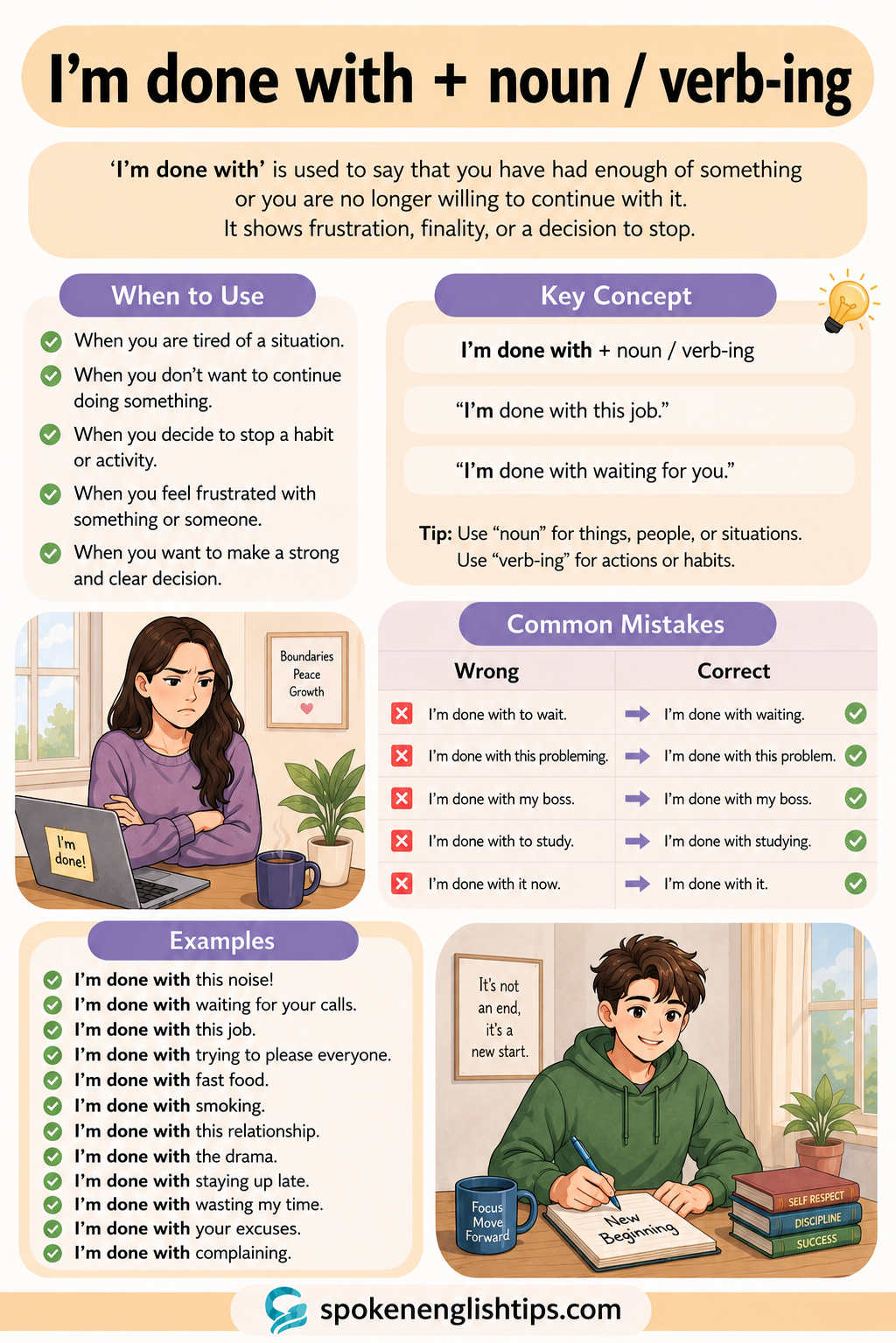
“I’m done with” is a common expression used in everyday English. People use it when they want to say they have finished something or they do not want to continue something anymore. You can use it with a noun or a verb ending in -ing. In real conversations, this phrase is very useful. For example, after completing homework, you can say, “I’m done with my homework.” If you are tired of waiting, you can say, “I’m done with waiting.” Friends, students, office workers, and family members use this phrase often in daily speaking. Learning this expression can help your English sound more natural and confident.
◎ Important Points
• Use I’m done with + noun when talking about finishing something.
• Use I’m done with + verb-ing for an activity or action.
• This phrase is common in daily spoken English.
• It can show completion or frustration.
• Do not use the base verb after “with.”
• Use it in home, office, school, and social conversations.
• The meaning changes based on the situation.
➤Key Concept
✅ Sentence Structure: Subject + am/is/are + done with + noun / verb-ing
Example:
I’m done with cleaning the kitchen.
“I’m done with” means you have finished something or you no longer want to continue it.
Speaking Tip:
Use this phrase in daily conversations to sound more natural and fluent.
➤ Common Mistakes To Avoid
| Common Mistake | Wrong Example | Correct Example |
|---|---|---|
| Using base verb after “with” | I’m done with clean the room. | I’m done with cleaning the room. |
| Missing “with” | I’m done my work. | I’m done with my work. |
| Wrong verb form | I’m done with to study. | I’m done with studying. |
| Wrong helping verb | I done with homework. | I’m done with homework. |
| Using incorrect noun form | I’m done with do my task. | I’m done with my task. |
➤ Examples
- I’m done with my homework now.
- I’m done with cooking dinner.
- I’m done with waiting for the bus.
- I’m done with this office project.
- I’m done with washing the clothes.
- I’m done with watching that movie.
- I’m done with my meeting for today.
- I’m done with answering emails.
- I’m done with cleaning my room.
- I’m done with discussing this issue.
➤ Practice Examples
Fill in the blanks
- I’m done with ______ my clothes.
- She is done with ______ dinner.
- We are done with ______ for the train.
- I’m done with my ______.
- They are done with ______ the report.
Change incorrect sentence to correct one
- I’m done with clean the house.
- I done with my homework.
- She is done cooking with dinner.
- We are done with to wait.
- I’m done my office work.
Speak this sentence aloud
- I’m done with my homework.
- I’m done with cleaning my room.
- I’m done with waiting here.
- I’m done with today’s work.
- I’m done with washing the dishes.