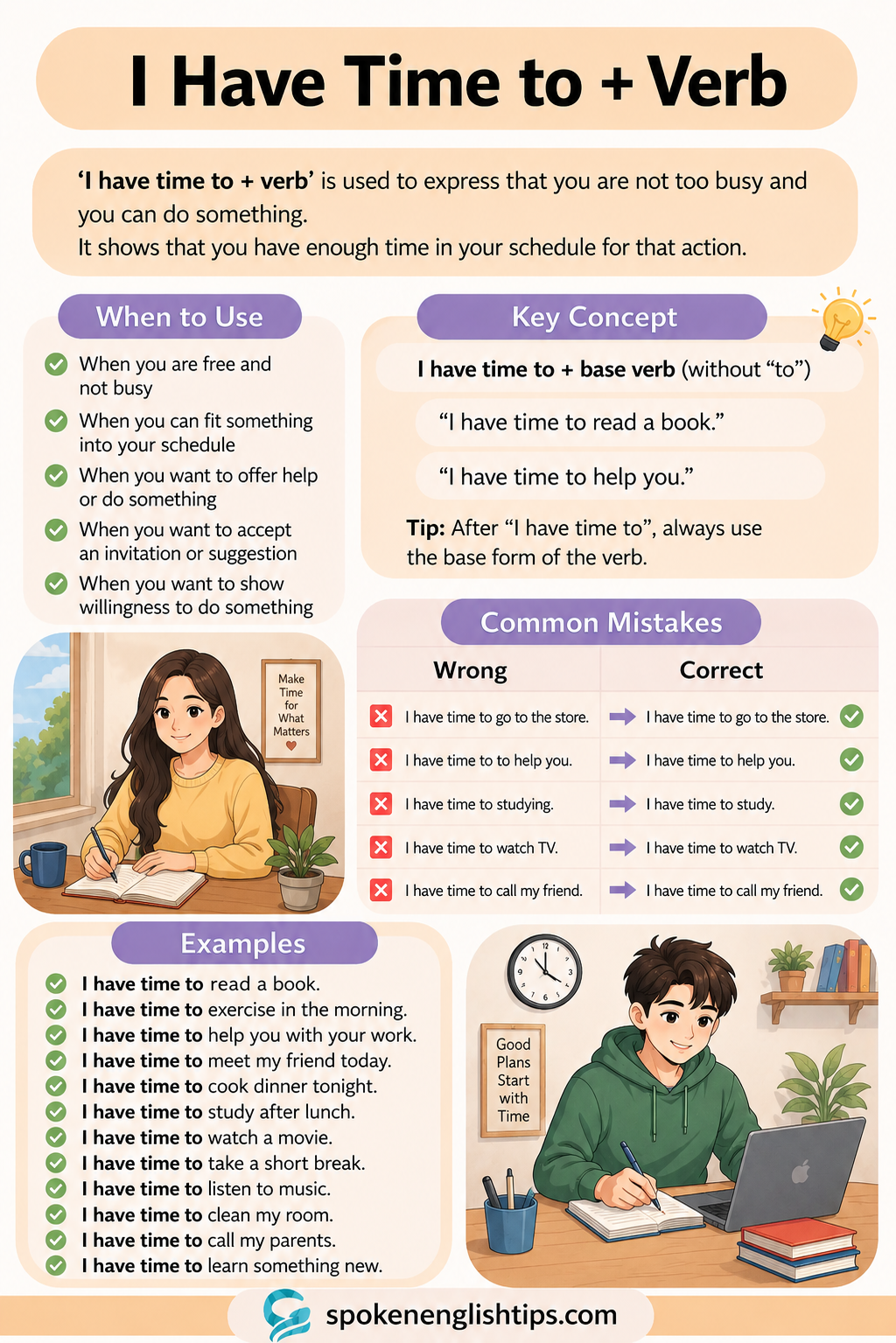
“I have time to + verb” is used when you want to say that you have enough free time to do something. People use this expression in daily conversations at home, at work, with friends, or while traveling. It helps you talk naturally about your schedule and activities. For example, if you finish your work early, you can say, “I have time to watch a movie.” If your day is busy, you can say, “I don’t have time to cook.” This sentence pattern is very useful because we often talk about time in real life. Learning it will make your English sound more natural and fluent during conversations.
◎ Important Points
• Use “have time to” before a verb.
• The verb after to should be in the base form.
• Use don’t have time to for negative sentences.
• Use Do/Does for questions.
• You can use it for present, past, or future situations.
• It is common in daily spoken English.
• Do not add -ing after to.
➤Key Concept
✅ Sentence Structure: Subject + have/has + time + to + verb + object
Example: I have time to finish my homework.
This pattern shows that someone has enough free time to do an action.
Speaking Tip: Try using this structure while talking about your daily routine.
➤ Common Mistakes To Avoid
| Common Mistake | Wrong Example | Correct Example |
|---|---|---|
| Using verb + ing | I have time to watching TV. | I have time to watch TV. |
| Missing “to” | I have time watch a movie. | I have time to watch a movie. |
| Wrong helping verb | I am have time to study. | I have time to study. |
| Using “has” with I | I has time to read. | I have time to read. |
| Wrong question form | Have you time to help me? | Do you have time to help me? |
➤ Examples
- I have time to clean my room before dinner.
- I have time to call my friend after work.
- We have time to visit the market today.
- She has time to read a book in the evening.
- Do you have time to meet me tomorrow?
- I don’t have time to cook today.
- My brother has time to play cricket after school.
- We have time to take some photos during the trip.
- I have time to answer your questions now.
- They have time to complete the project today.
➤ Practice Examples
Fill in the blanks
- I have time to _______ a movie.
- She has time to _______ her homework.
- We have time to _______ our grandparents.
- They have time to _______ lunch together.
- Do you have time to _______ me?
Change incorrect sentence to correct one
- I have time to playing football.
- She have time to cook dinner.
- We have time visit the park.
- He has time to studying English.
- I am have time to read books.
Speak this sentence aloud
- I have time to help my parents today.
- I have time to learn something new.
- We have time to go shopping after work.
- I don’t have time to watch TV now.
- Do you have time to talk with me?
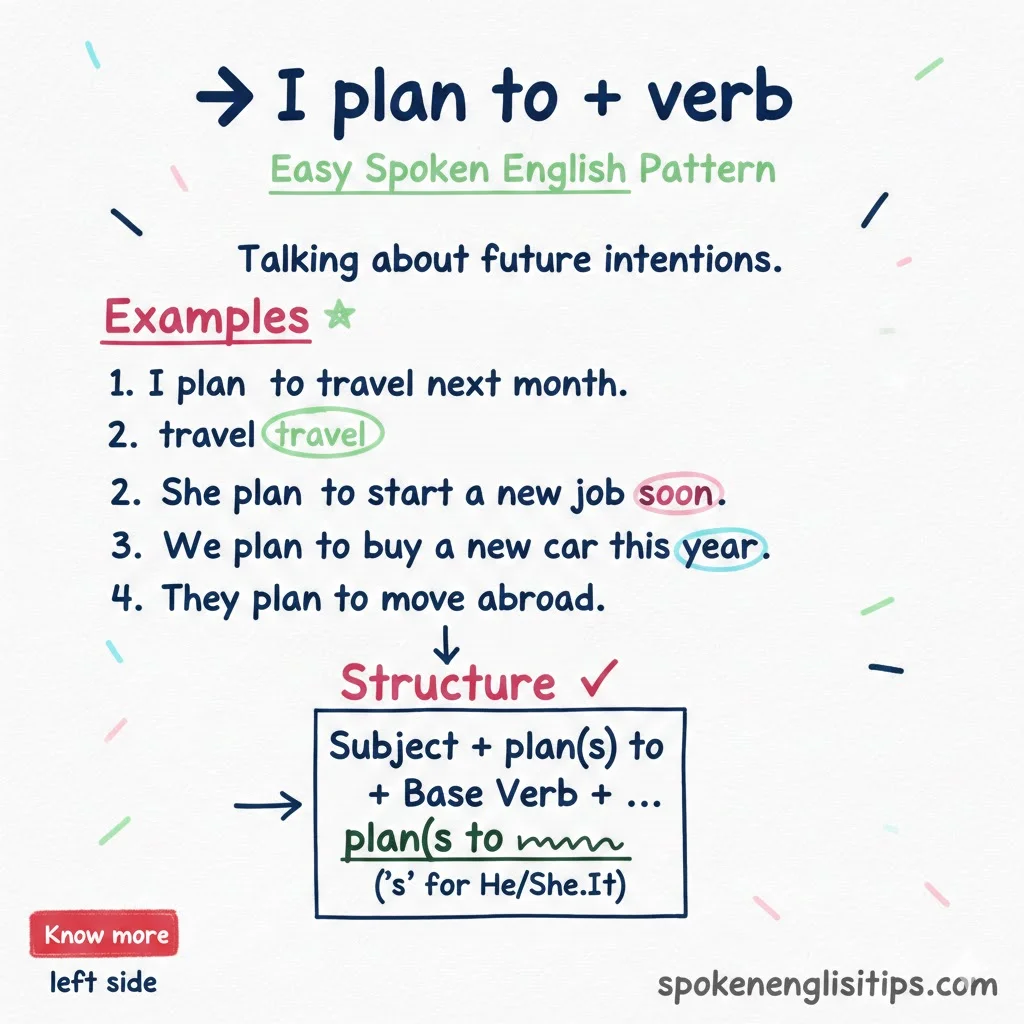
We use “I plan to + verb” when we talk about something we want to do in the future. It shows intention.
◎ Important Points
➤Key Concept
➤ Common Mistakes To Avoid
➤ Examples
➤ Practice Examples