Have you ever wondered what we call a group of birds, lions, students, or flowers? The answer is collective nouns. These special words make English more interesting and help you describe a group of people, animals, places, or things with a single word.
In this guide, you’ll discover 100 examples of collective nouns that are commonly used in everyday English. Whether you’re a student, English learner, teacher, or preparing for competitive exams, this list will help you improve your vocabulary and make your writing and speaking more natural.
We’ve included easy-to-understand examples so you can quickly learn the meaning and correct usage of each collective noun. By the end of this article, you’ll have a stronger understanding of collective nouns and know when to use them confidently in real-life conversations and writing.
Let’s explore the complete list of 100 collective nouns and make learning English simple and enjoyable!
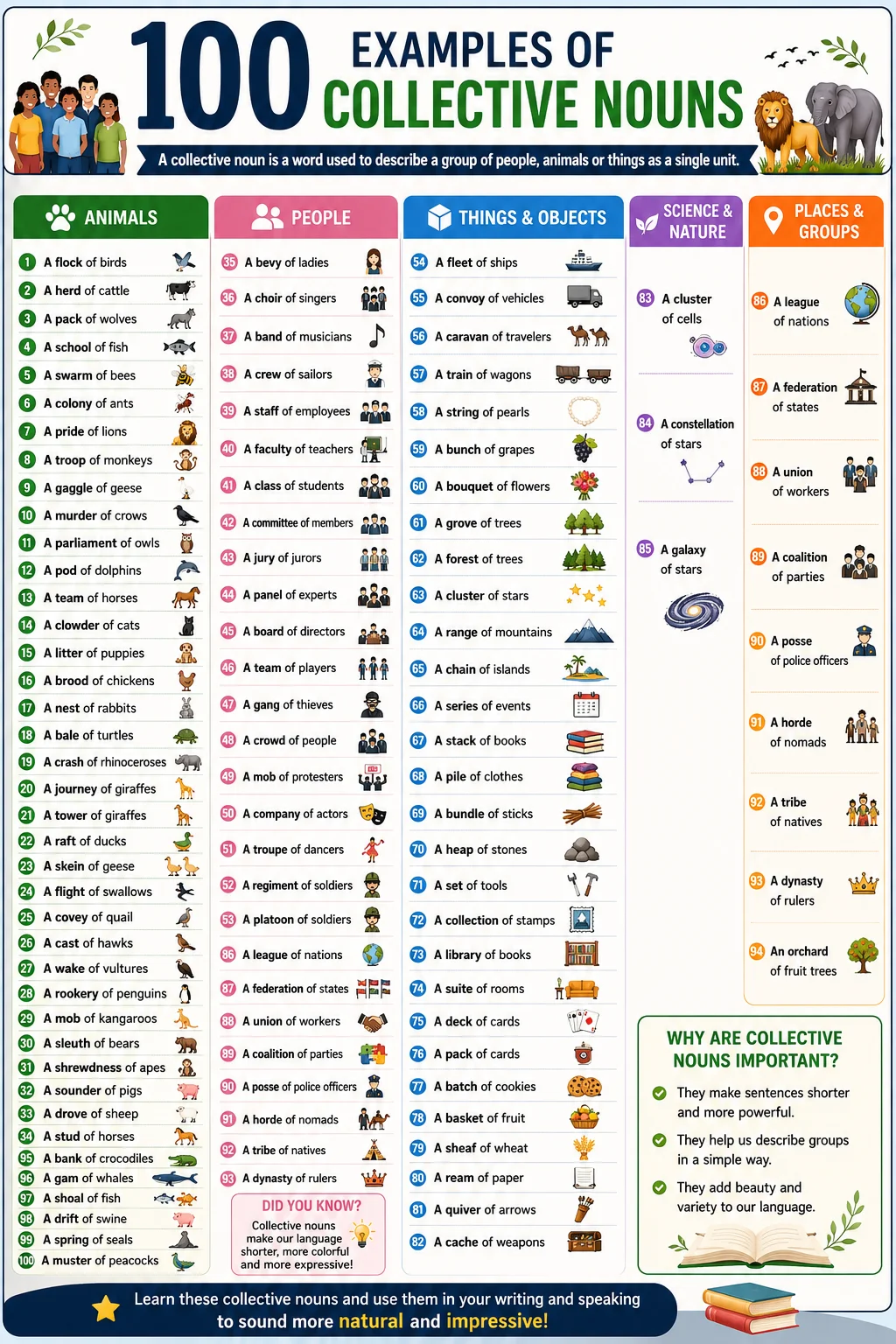
100 Examples of Collective Nouns
Here are 100 examples of collective nouns:
- A flock of birds
- A herd of cattle
- A pack of wolves
- A school of fish
- A swarm of bees
- A colony of ants
- A pride of lions
- A troop of monkeys
- A gaggle of geese
- A murder of crows
- A parliament of owls
- A pod of dolphins
- A team of horses
- A clowder of cats
- A litter of puppies
- A brood of chickens
- A nest of rabbits
- A bale of turtles
- A crash of rhinoceroses
- A journey of giraffes
- A tower of giraffes
- A raft of ducks
- A skein of geese
- A flight of swallows
- A covey of quail
- A cast of hawks
- A wake of vultures
- A rookery of penguins
- A mob of kangaroos
- A sleuth of bears
- A shrewdness of apes
- A sounder of pigs
- A drove of sheep
- A stud of horses
- A bevy of ladies
- A choir of singers
- A band of musicians
- A crew of sailors
- A staff of employees
- A faculty of teachers
- A class of students
- A committee of members
- A jury of jurors
- A panel of experts
- A board of directors
- A team of players
- A gang of thieves
- A crowd of people
- A mob of protesters
- A company of actors
- A troupe of dancers
- A regiment of soldiers
- A platoon of soldiers
- A fleet of ships
- A convoy of vehicles
- A caravan of travelers
- A train of wagons
- A string of pearls
- A bunch of grapes
- A bouquet of flowers
- A grove of trees
- A forest of trees
- A cluster of stars
- A range of mountains
- A chain of islands
- A series of events
- A stack of books
- A pile of clothes
- A bundle of sticks
- A heap of stones
- A set of tools
- A collection of stamps
- A library of books
- A suite of rooms
- A deck of cards
- A pack of cards
- A batch of cookies
- A basket of fruit
- A sheaf of wheat
- A ream of paper
- A quiver of arrows
- A cache of weapons
- A cluster of cells
- A constellation of stars
- A galaxy of stars
- A league of nations
- A federation of states
- A union of workers
- A coalition of parties
- A posse of police officers
- A horde of nomads
- A tribe of natives
- A dynasty of rulers
- An orchard of fruit trees
- A bank of crocodiles
- A gam of whales
- A shoal of fish
- A drift of swine
- A spring of seals
- A muster of peacocks
Definition: A collective noun is a word used to describe a group of people, animals, or things as a single unit. For example, in “a flock of birds,” the word flock is the collective noun.