Many English learners get confused between above and over because both words can mean “higher than something.”
In many situations, they seem similar:
✅ The airplane is above the clouds.
✅ The airplane is over the clouds.
But native speakers don’t always use them the same way.
Today, you’ll learn the Difference Between Above and Over through simple explanations, natural examples, and real-life conversations so you can use them confidently in everyday English.
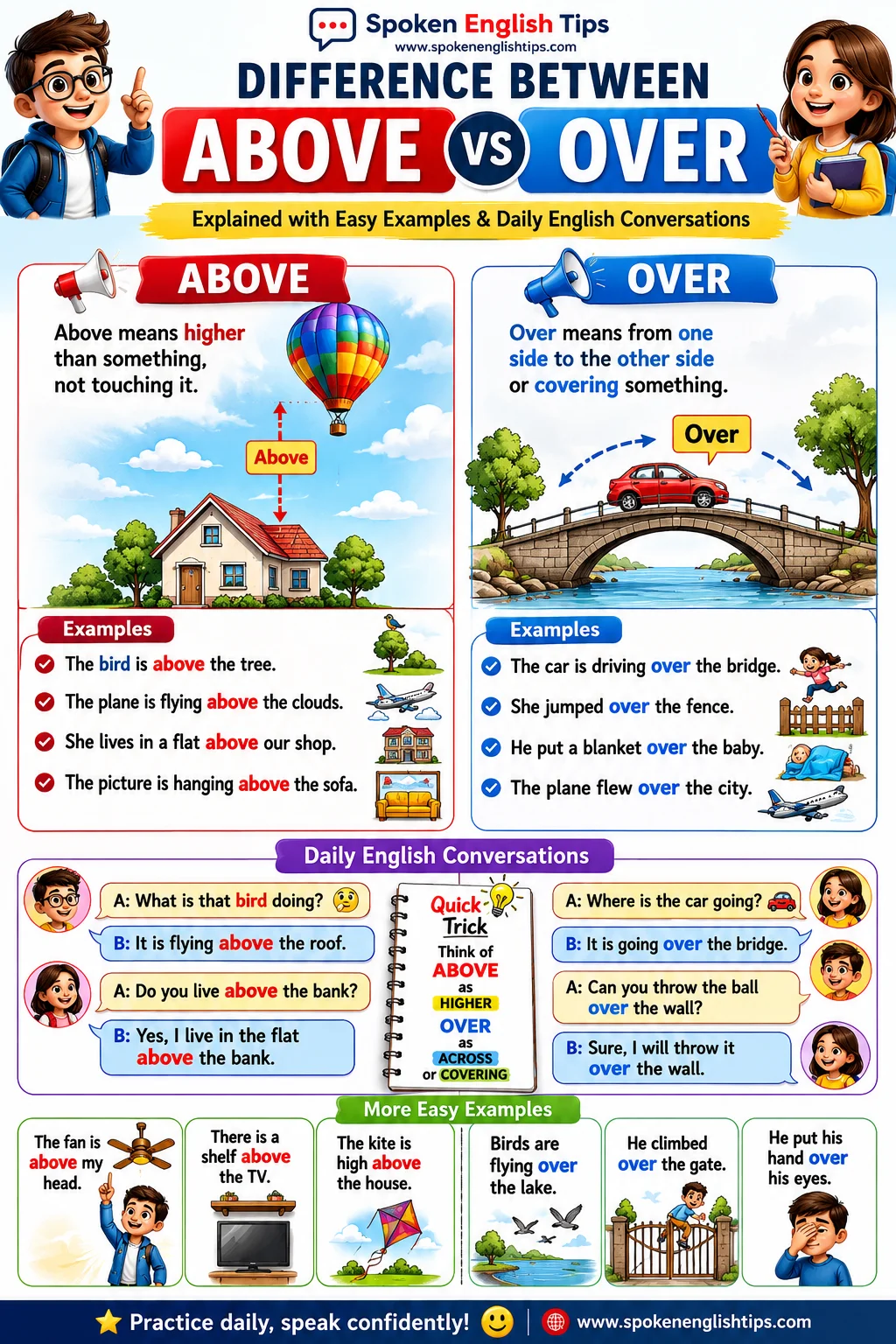
Quick Understanding
Above
Above means at a higher level than something.
It focuses on position.
Example:
- The picture is above the sofa.
- The temperature is above 40 degrees.
- His office is above mine.
- Difference Between Above and Over with Examples
- 100+ Best Daily English sentences For Everyone
- 100+ Common Daily Sentences in English for Everyday Use
- Can You Start a Sentence With And
- 100 Free Daily Use English Sentences For Conversations
Over
Over usually means higher than something and often suggests:
- covering something
- moving across something
- being directly above something
Example:
- The bridge goes over the river.
- She put a blanket over the baby.
- The plane flew over the city.
Difference Between Above and Over
| Above | Over |
|---|---|
| Shows position | Shows position, movement, or covering |
| Not necessarily directly higher | Often directly higher |
| Used for measurements and levels | Used for crossing and covering |
| More static | Can suggest movement |
Example
Above:
The clock is above the door.
(Only talking about position.)
Over:
The lamp hangs over the table.
(Directly higher than the table.)
Real-Life Conversation: At Home
Conversation 1
Mother: Where should I hang this painting?
Son: Put it above the television.
Mother: Is this position okay?
Son: Yes, it looks perfect above it.
Key Expression
Put it above the television.
Meaning: Place it at a higher position than the television.
Real-Life Conversation: Looking at the Sky
Conversation 2
Rahul: Look at that helicopter.
Amit: It’s flying over the stadium.
Rahul: Yes, it’s moving toward the city.
Amit: It looks really low today.
Key Expression
Flying over the stadium
Meaning: Moving across the area above the stadium.
When to Use “Above”
Use above when talking about levels, rankings, positions, or measurements.
Examples
- The fan is above my head.
- Water came above my knees.
- She scored above average in the exam.
- The office is above the bank.
- Temperatures stayed above 35°C.
Common Spoken Sentences
- That’s above my understanding.
- Your score is above mine.
- The shelf above the desk is empty.
- The picture above the fireplace looks beautiful.
When to Use “Over”
Use over when something is:
- covering another thing
- moving across something
- directly higher than something
Examples
- Put a cloth over the table.
- The bird flew over the lake.
- The bridge goes over the river.
- He jumped over the wall.
- She placed her hand over her mouth.
Common Spoken Sentences
- Come over here.
- The game is over.
- He spilled coffee all over the floor.
- The airplane passed over our house.
Everyday Situations
Situation 1: Office
❌ The lamp is over the wall.
✅ The lamp is above the wall.
Reason: We’re talking about position.
Situation 2: Travel
❌ The plane flew above the city.
✅ The plane flew over the city.
Reason: The plane is moving across the city.
Useful Expressions with Above
Above all
Meaning: Most importantly
Examples:
- Above all, be honest.
- Above all, stay safe.
Above average
Meaning: Better than normal
Examples:
- Her English is above average.
- He earns an above-average salary.
Useful Expressions with Over
Over and over
Meaning: Repeatedly
Examples:
- I watched the video over and over.
- She practiced the speech over and over.
All over
Meaning: Everywhere
Examples:
- There are books all over the room.
- News spread all over the country.
Practice Conversation
Conversation 3
Priya: Why are there so many birds over the lake?
Neha: They’re looking for food.
Priya: Look at that tree above the bench.
Neha: Yes, it gives good shade.
Vocabulary
- Lake = a large area of water
- Bench = a long seat
- Shade = protection from sunlight
Final Thoughts
Understanding the Difference Between Above and Over becomes much easier when you focus on their purpose.
- Above usually talks about a higher position or level.
- Over often talks about movement, crossing, covering, or being directly higher than something.
The best way to master these words is to notice how native speakers use them in real conversations and then practice using them in your own daily English sentences.
Today’s Speaking Challenge: Make 5 sentences using above and 5 sentences using over, then try speaking them aloud naturally.


