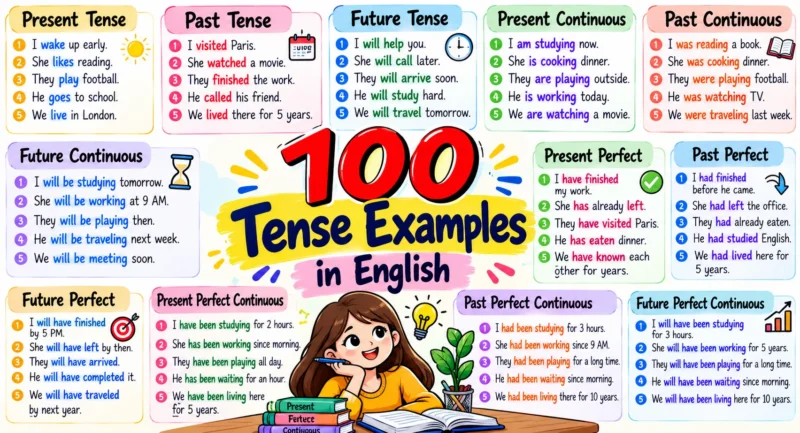
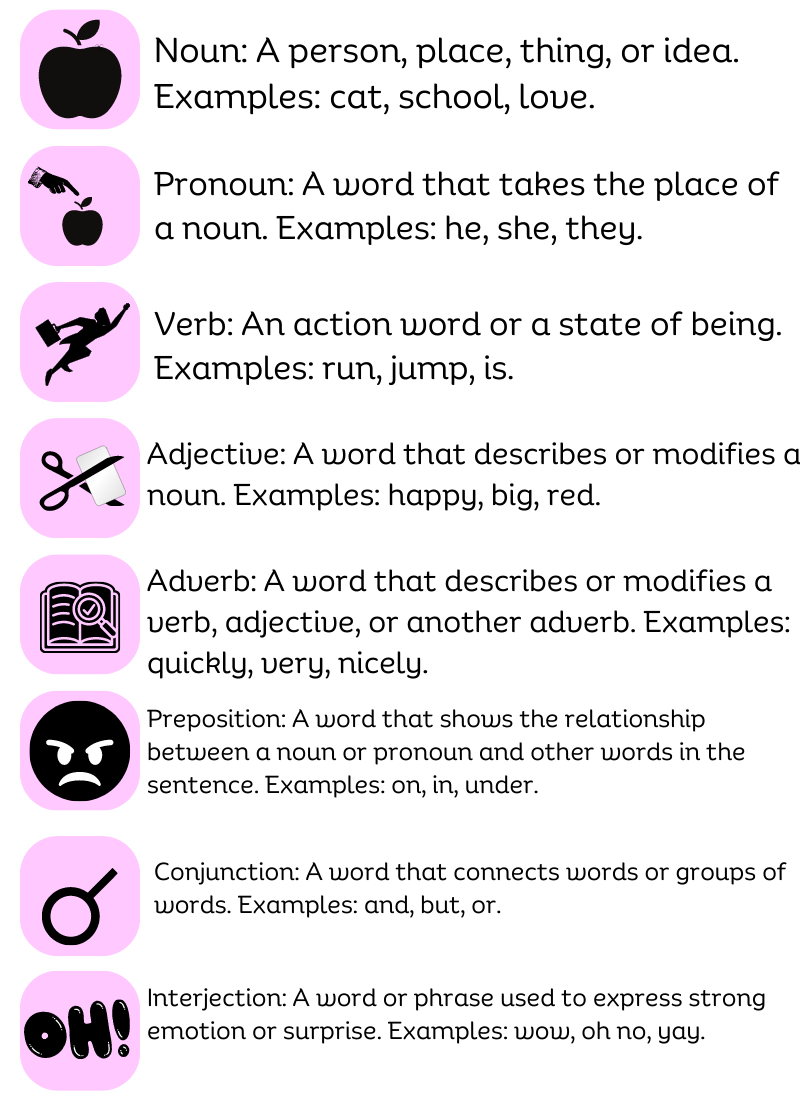
English tenses may look difficult at first—but once you see all of them together, they become much easier to understand.
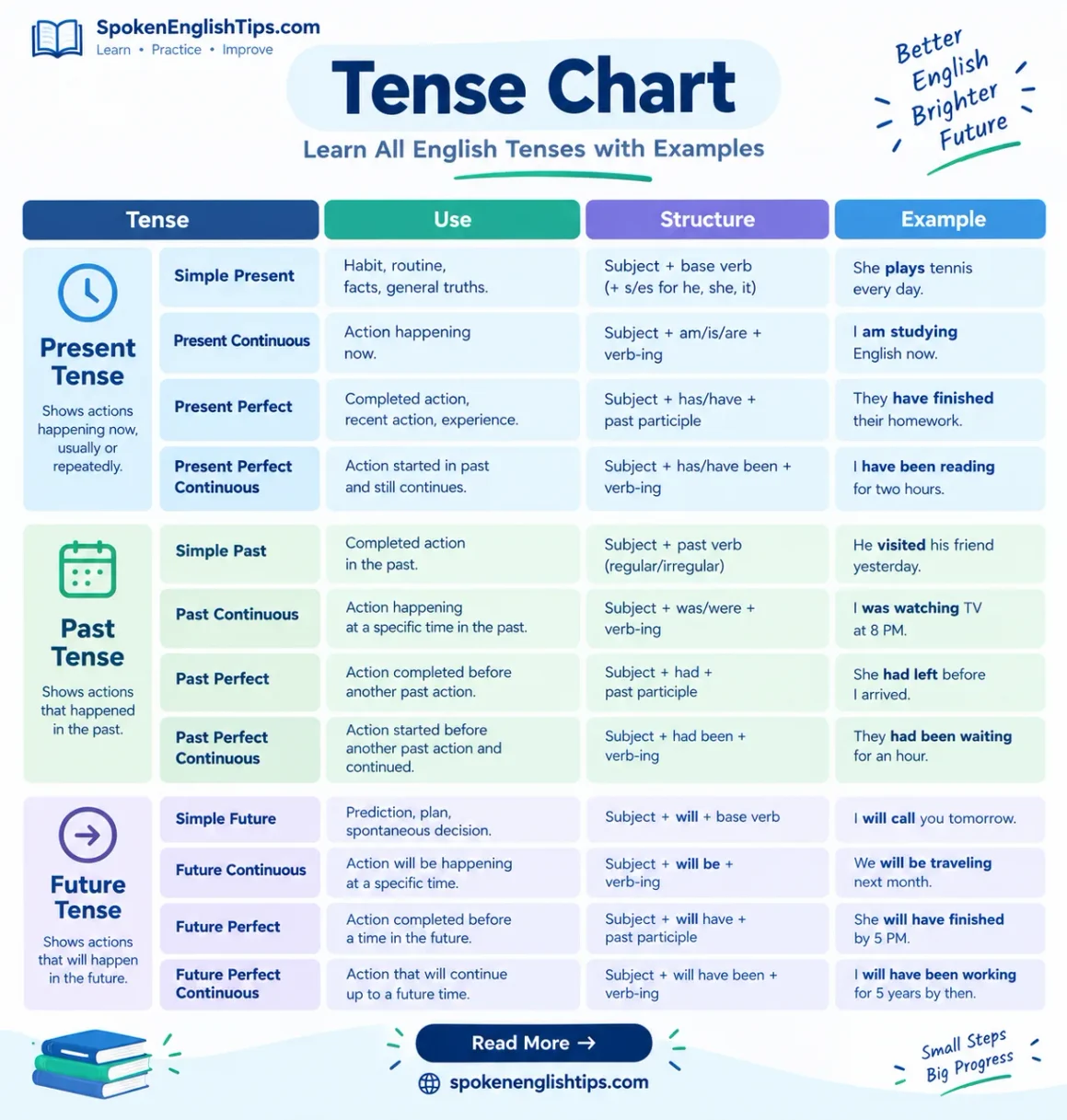
A tense chart gives you a quick view of how English tenses work. Instead of reading long grammar explanations, you can compare the tense, structure, use, and example in one place.
There are 12 main tenses in English. They are divided into three main groups:
- Present Tense
- Past Tense
- Future Tense
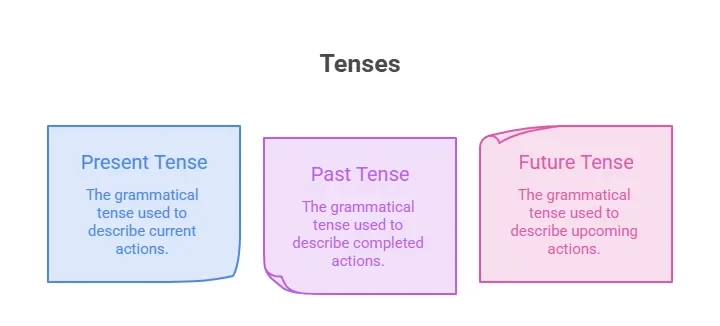
Each group has four forms: Simple, Continuous, Perfect, and Perfect Continuous.
So, the complete pattern is:
3 time periods × 4 forms = 12 tenses.
If you are learning English grammar, preparing for an exam, improving your writing, or trying to speak more accurately, the following 12 tenses chart can be used as a quick revision note.
The Three Main Types of Tenses
Before looking at the full chart, understand one simple idea.
Present tense talks mainly about things happening now, regularly, or connected with the present.
Past tense talks about actions or situations that happened before now.
Future tense talks about actions or situations expected to happen later.
Each of these is then divided into four different forms.
Present Tenses
The four present tenses are:
- Simple Present – I work.
- Present Continuous – I am working.
- Present Perfect – I have worked.
- Present Perfect Continuous – I have been working.
Past Tenses
The four past tenses are:
- Simple Past – I worked.
- Past Continuous – I was working.
- Past Perfect – I had worked.
- Past Perfect Continuous – I had been working.
Future Tenses
The four future tenses are:
- Simple Future – I will work.
- Future Continuous – I will be working.
- Future Perfect – I will have worked.
- Future Perfect Continuous – I will have been working.
Tense Chart – All 12 Tenses
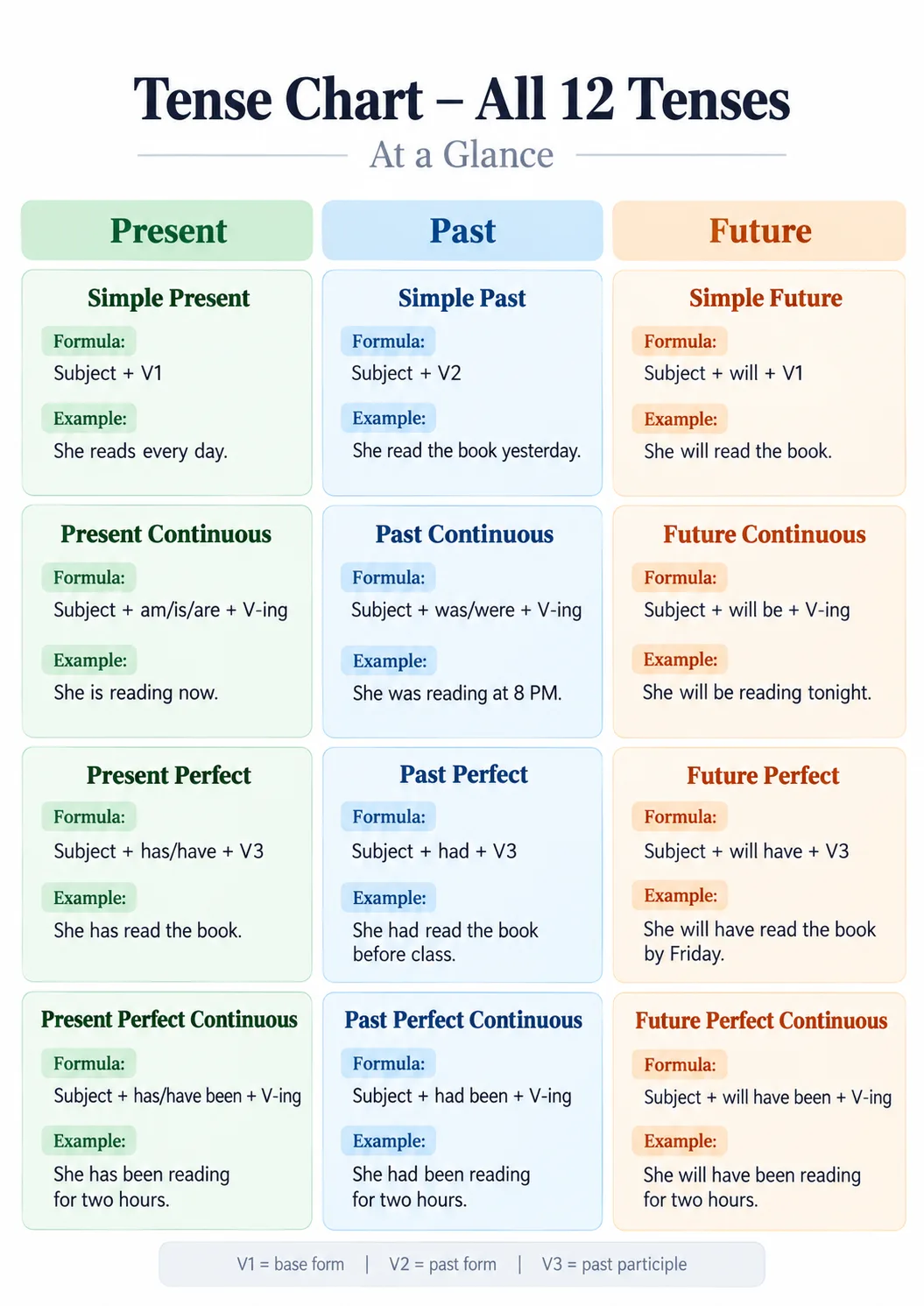
Your chart should ideally contain these columns:
Tense | Structure | Main Use | Example
You can use the following information in your chart:
| Tense | Basic Structure | Main Use | Example |
|---|---|---|---|
| Simple Present | Subject + V1 | Habits, routines, facts | She reads every day. |
| Present Continuous | Subject + am/is/are + V-ing | Action happening now | She is reading now. |
| Present Perfect | Subject + has/have + V3 | Completed action connected to the present | She has read the book. |
| Present Perfect Continuous | Subject + has/have been + V-ing | Action continuing for a period of time | She has been reading for two hours. |
| Simple Past | Subject + V2 | Completed past action | She read the book yesterday. |
| Past Continuous | Subject + was/were + V-ing | Action continuing at a past time | She was reading at 8 PM. |
| Past Perfect | Subject + had + V3 | Action completed before another past action | She had read the book before class. |
| Past Perfect Continuous | Subject + had been + V-ing | Continuing action before another past event | She had been reading for two hours. |
| Simple Future | Subject + will + V1 | Future action or decision | She will read the book. |
| Future Continuous | Subject + will be + V-ing | Action continuing at a future time | She will be reading tonight. |
| Future Perfect | Subject + will have + V3 | Action completed before a future time | She will have read the book by Friday. |
| Future Perfect Continuous | Subject + will have been + V-ing | Action continuing up to a future point | She will have been reading for two hours. |
How to Read the Tense Chart
Do not try to memorize all 12 tenses at the same time.
First, look at the time.
Ask yourself:
Is the action in the present, past, or future?
Next, look at the type of action.
Is it a normal action? Is it continuing? Is it completed? Or has it been continuing for some time?
This gives you a simple pattern:
- Simple = general or basic action.
- Continuous = action in progress.
- Perfect = action connected with another time or completed before a point.
- Perfect Continuous = action continuing for a period of time.
For example:
I study English.
This is Simple Present because it describes a regular activity.
I am studying English.
This is Present Continuous because the activity is happening now.
I have studied English.
This is Present Perfect because the action has been completed and is connected with the present.
I have been studying English for two hours.
This is Present Perfect Continuous because the action has continued for a period of time.
The same basic idea can help you understand past and future tenses.
Quick Tense Formula
You can also remember the 12 tenses through this simple tense formula pattern:
1. Simple → Basic verb form
2. Continuous → Be + V-ing
3. Perfect → Have + V3
4. Perfect Continuous → Have + Been + V-ing
The helping verb changes according to the tense.
For example:
- Present Continuous: am/is/are + V-ing
- Past Continuous: was/were + V-ing
- Future Continuous: will be + V-ing
- Present Perfect: has/have + V3
- Past Perfect: had + V3
- Future Perfect: will have + V3
Once you understand this pattern, learning the complete English tense chart becomes much easier.
V1, V2 and V3 in Tenses
You will often see V1, V2, and V3 in tense formulas.
They simply mean different forms of a verb.
For example, take the verb write:
- V1 – write
- V2 – wrote
- V3 – written
Another example:
- V1 – go
- V2 – went
- V3 – gone
So, when a tense formula says Subject + V2, you need the second form of the verb.
When it says Subject + has/have + V3, you need the third form.
One Verb in Different Tenses
Using one verb across different tenses can make the pattern easier to see.
Take the verb work:
I work every day.
Simple Present
I am working now.
Present Continuous
I worked yesterday.
Simple Past
I was working yesterday evening.
Past Continuous
I have worked here for five years.
Present Perfect
I will work tomorrow.
Simple Future
Notice how the meaning changes when the tense changes—even though the main action remains the same.
Easy Way to Remember the 12 Tenses
Instead of memorizing twelve completely different grammar rules, remember this:
Present, Past, Future
and then:
Simple, Continuous, Perfect, Perfect Continuous
Combine them, and you get all 12 tenses.
- Present + Simple = Simple Present
- Present + Continuous = Present Continuous
- Present + Perfect = Present Perfect
- Present + Perfect Continuous = Present Perfect Continuous
Follow the same pattern for Past and Future.
This small trick makes the entire English tense chart easier to remember.
Final Note
You do not need to memorize the complete tense chart in one day.
Start with the three basic time periods—present, past, and future. Then understand the difference between simple, continuous, perfect, and perfect continuous.
Keep the chart nearby while writing sentences, reading English, or practising grammar. Over time, you will begin to recognize tense patterns naturally.
The purpose of a tense chart is not only to help you memorize formulas; it should help you understand when and why a tense is used.
Once that becomes clear, all 12 English tenses become far less confusing.
Read More
| Tense Formula Chart | Click Here |
| 100 Tense Examples in English | Click Here |