An MBA in Finance can teach you financial modelling, accounting, valuation, investment analysis, risk management, and many other technical skills. But students sometimes discover this late: knowing finance is only part of becoming good at finance!
You also need to explain numbers clearly, work with different people, question assumptions, handle pressure, solve problems, and make sensible decisions.
These abilities are usually called soft skills.
And they aren’t just “nice to have.” In a 2026 CFA Institute survey of 500 finance managers, soft skills were identified as the biggest skills gap among new finance professionals. The research also found that 67% of surveyed managers identified soft skills as a key factor in a professional’s employability.
So, if you’re studying MBA Finance, improving your technical knowledge is important—but developing the right human skills alongside it can make you a much more complete finance professional.
In this guide, we’ll look at 10 important soft skills for MBA Finance students, why each one matters, how it appears in real finance work, and, most importantly, how you can start improving it.
What Are Soft Skills in MBA Finance?
Soft skills are personal and professional abilities that influence how you think, communicate, work with others, solve problems, and respond to different situations.
Think about it this way.
Financial modelling is a technical skill.
But explaining the results of that model to a manager who doesn’t understand financial modelling? That’s communication.
Creating a valuation is a technical skill.
Questioning whether the assumptions behind that valuation are realistic? That’s critical thinking.
Preparing a financial presentation is technical work.
Presenting it confidently, answering difficult questions, and defending your recommendation? Those require several soft skills working together.
That’s why successful finance professionals generally need a combination of both.
| Technical Skills | Soft Skills |
|---|---|
| Financial Modelling | Communication |
| Accounting | Critical Thinking |
| Excel | Problem-Solving |
| Valuation | Decision-Making |
| Financial Analysis | Financial Storytelling |
| Risk Analysis | Adaptability |
| Data Analysis | Teamwork |
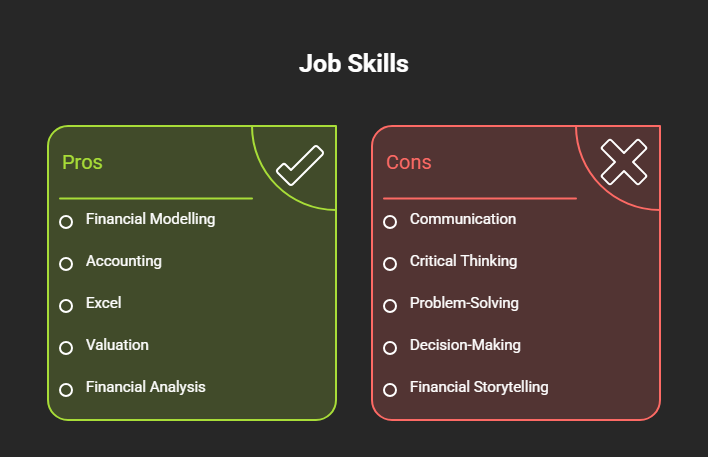
Technical skills help you perform finance work. Soft skills help you understand, communicate, challenge, and use that work effectively.
Why Are Soft Skills Important for MBA Finance Students?
The finance industry is changing quickly.
AI can analyze information. Software can automate reports. Excel can calculate thousands of numbers in seconds. Financial platforms can process enormous amounts of data.
But somebody still needs to ask:
What do these numbers actually mean?
Is this assumption reasonable?
What risk are we missing?
How should we explain this to the client?
Which option should the company choose?
That’s where human skills become extremely valuable.
The World Economic Forum’s Future of Jobs Report 2025 found analytical thinking remained the most sought-after core skill among employers surveyed. Resilience, flexibility and agility, along with leadership and social influence, were also among the leading skills.
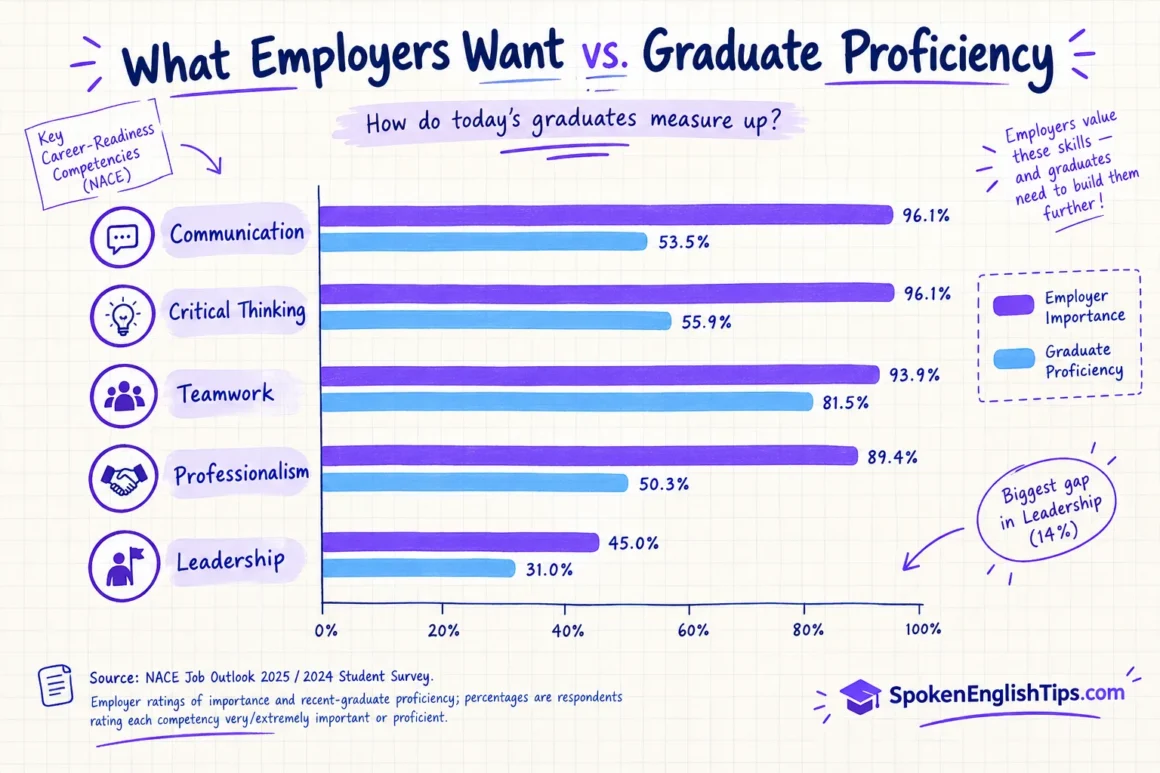
Employer research from the National Association of Colleges and Employers (NACE) tells a similar story.
| Competency | Employers Rating It Important | Employers Rating Graduates Highly Proficient |
|---|---|---|
| Communication | 96.1% | 53.5% |
| Critical Thinking | 96.1% | 55.9% |
| Teamwork | 93.9% | 81.5% |
| Professionalism | 89.4% | 50.3% |
| Leadership | 45.0% | 31.0% |
These numbers reveal something interesting.
Employers may want these abilities, but graduates don’t always enter the workplace fully prepared to demonstrate them.
For an MBA Finance student, that’s an opportunity.
1. Communication Skills
You can be brilliant with numbers, but if nobody understands your explanation, your analysis loses much of its value.
That’s why communication is one of the most important soft skills for MBA Finance students.
Finance professionals regularly communicate with managers, investors, clients, colleagues, auditors, bankers, and people from non-finance departments.
And those people won’t always understand financial jargon.
Imagine you’ve analyzed a company’s quarterly performance and discovered that operating costs increased by 14%.
You could simply say:
“Operating expenses increased by 14%.”
Technically correct—but not especially helpful.
A better explanation might be:
“Operating expenses increased by 14%, mainly because logistics and marketing costs rose during the quarter. Revenue also increased, but not enough to offset the additional costs, which reduced the company’s operating margin.”
Now you’re communicating information, not simply repeating a number.
How can you improve this skill?
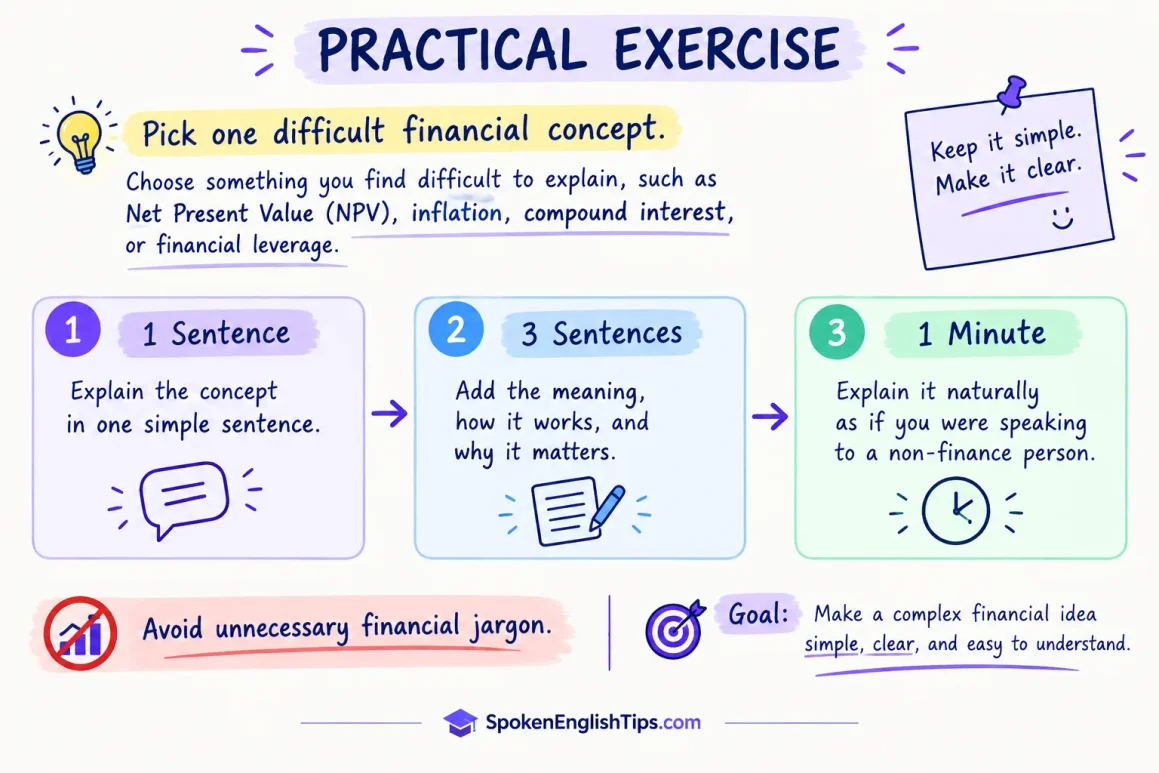
Practise explaining financial concepts in plain English. Give presentations during MBA projects. Write short summaries of financial reports. Participate in discussions, case competitions, and group presentations.
One particularly useful exercise is this:
Choose a financial concept—such as EBITDA, inflation, working capital, or P/E ratio—and explain it to someone who has never studied finance.
If they understand you, you’re improving.
2. Critical Thinking
Finance isn’t simply about finding numbers.
It’s about knowing which numbers matter, whether you can trust them, and what they actually tell you.
That’s critical thinking.
Suppose someone tells you:
“Company X is an excellent investment because its revenue increased by 25%.”
A weak analysis might stop there.
A critical thinker starts asking questions.
Did profit increase too?
What happened to margins?
Did debt increase?
Was the revenue growth organic?
Was it caused by an acquisition?
Is the growth sustainable?
How does the company compare with competitors?
Suddenly, one attractive number becomes a much deeper investigation.
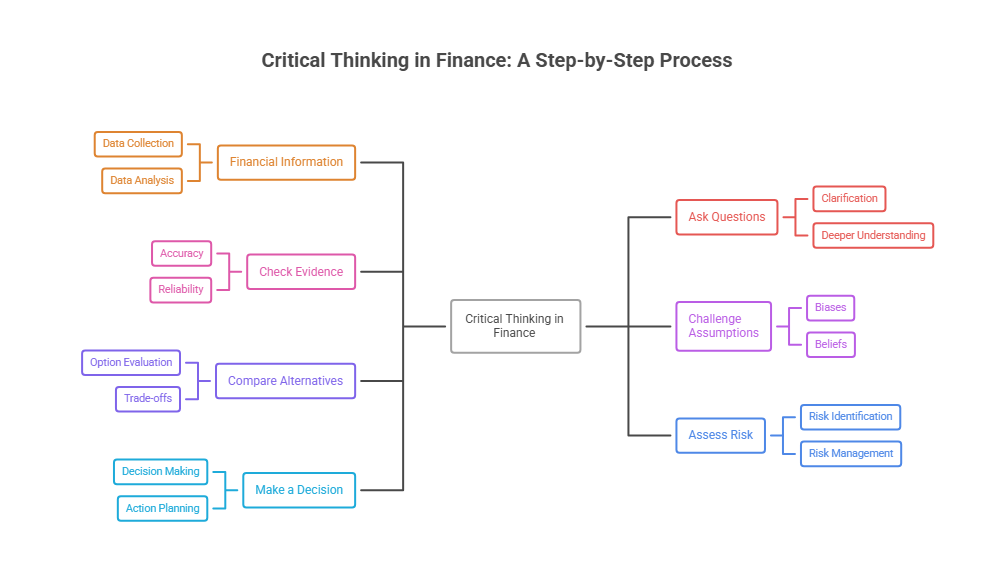
A useful thinking process is:
Question → Evidence → Assumptions → Alternatives → Risk → Conclusion
This habit is extremely valuable in financial analysis, investment research, consulting, risk management, and corporate finance.
How can you improve it?
Whenever you read a financial claim, don’t immediately accept or reject it.
Ask:
What evidence supports this?
What assumption is being made?
What information might be missing?
Is there another explanation?
What could prove this conclusion wrong?
Those questions train your brain to analyze rather than simply consume information.
3. Problem-Solving Skills
Critical thinking and problem-solving are closely connected—but they’re not exactly the same.
Critical thinking helps you understand the problem.
Problem-solving helps you decide what to do about it.
Imagine a company has this situation:
Revenue is growing.
Customers are increasing.
Yet profit is falling.
What’s happening?
A good finance professional won’t jump to the first explanation.
You might investigate operating expenses, gross margins, employee costs, customer acquisition costs, interest expenses, pricing, logistics, inventory, debt, or changes in product mix.
Once you identify the likely causes, you can evaluate possible solutions.
That’s real problem-solving.
How can MBA students improve it?
Case studies are extremely useful.
Instead of memorizing the “correct” answer, try developing two or three possible solutions. Then compare the costs, benefits, risks, and likely results of each.
That is much closer to how business decisions work in the real world.
4. Financial Storytelling
This skill deserves special attention.
A spreadsheet can contain thousands of numbers.
A decision-maker usually wants to know:
“So…what does all this mean?”
Financial storytelling means turning numbers into a clear business message.
Consider this statement:
“Revenue increased by 12%.”
That’s data.
Now consider:
“Revenue increased by 12%, largely because online sales grew. However, customer acquisition costs increased at an even faster rate, putting pressure on margins.”
Now we have a story.
You have connected the number to its cause and business meaning.
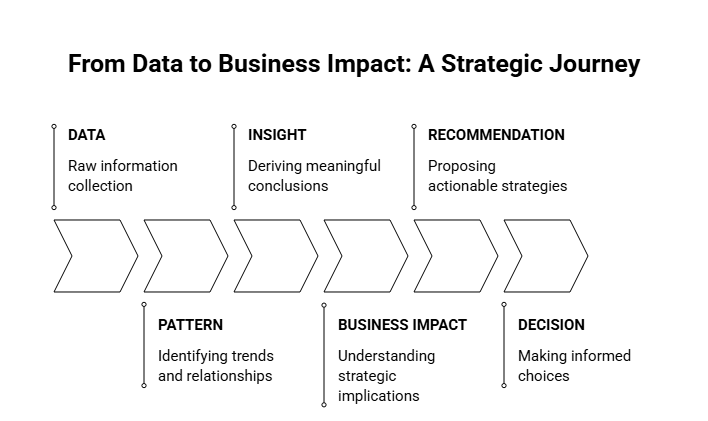
Good financial storytelling usually follows a simple path:
Data → Pattern → Insight → Business Meaning → Recommendation
This skill can be especially valuable in FP&A, investment research, consulting, corporate finance, management reporting, and investor presentations.
How can you improve it?
Take a financial chart and explain it without reading every number.
Answer only three questions:
What happened?
Why does it matter?
What should happen next?
5. Emotional Intelligence
Finance involves numbers.
But finance also involves people—and people don’t always behave like spreadsheets!
Emotional intelligence is the ability to understand and manage your own emotions while also recognizing and responding appropriately to other people’s emotions.
Imagine you’re working with an investment client whose portfolio has fallen sharply.
The client is worried.
Maybe they’re angry.
Technical knowledge helps you explain what happened to the portfolio.
Emotional intelligence helps you listen carefully, remain calm, understand the client’s concern, and communicate without making the situation worse.
The same skill matters inside organizations.
You might disagree with your manager.
A teammate might reject your recommendation.
A client might criticize your analysis.
Your presentation might go badly.
Emotional intelligence helps you respond professionally instead of reacting emotionally.
How can you improve it?
Listen without interrupting.
Ask questions before assuming what someone means.
Learn to accept constructive criticism.
And when a conversation becomes difficult, focus on the problem rather than attacking the person.
6. Teamwork and Collaboration
A finance department doesn’t operate on another planet.
Finance professionals work with almost every part of an organization.
Marketing may need a campaign budget.
HR may need compensation planning.
Operations may need cost analysis.
Sales may need revenue forecasts.
Management may need financial projections.
Legal may need help understanding financial implications.
Technology teams may work with finance on automation and data systems.
That’s why teamwork matters.
During your MBA, group projects can actually be useful training for this—even when they’re frustrating!
You’ll meet people who think differently, work at different speeds, disagree with you, or approach problems differently.
Learning how to work effectively with them is part of professional development.
7. Leadership and Influence
You don’t need the word “Manager” in your job title to demonstrate leadership.
That’s a common misunderstanding.
Leadership can be as simple as taking responsibility when a group is stuck.
Maybe nobody knows how to divide an MBA project.
You create the plan.
Maybe two teammates disagree.
You help the group find common ground.
Maybe your team’s analysis contains an error.
Instead of blaming somebody, you help fix it.
That’s leadership too.
For MBA Finance students, leadership may involve taking ownership, communicating confidently, helping teams make decisions, managing disagreements, and accepting responsibility for results.
NACE’s career-readiness framework describes leadership around recognizing and using personal and team strengths to achieve organizational goals.
So don’t wait until you become a manager to start practising it.
Start during presentations, internships, college clubs, finance competitions, projects, and case studies.
8. Adaptability and Resilience
Finance is changing.
AI tools are becoming more capable.
Automation is changing repetitive work.
Financial software keeps evolving.
Regulations change.
Markets rise and fall.
New technologies appear.
Client expectations change.
You won’t be able to learn one system at age 25 and use exactly the same knowledge until retirement.
Adaptability means being willing and able to adjust.
Resilience means continuing to function effectively when things don’t go according to plan.
Imagine you’ve spent two weeks developing an investment thesis.
Then new economic data appears—and it weakens your argument.
What do you do?
Defend your old conclusion because you’ve already invested two weeks in it?
Or reassess the evidence?
A strong professional should be willing to say:
“The information changed, so my conclusion needs to change too.”
That’s not weakness.
That’s good judgment.
The World Economic Forum’s Future of Jobs Report 2025 identifies resilience, flexibility, and agility among the leading core skills employers expect from workers.
For finance students, the lesson is simple: learn how to learn.
9. Time Management and Prioritization
Finance students and professionals often deal with several deadlines at once.
Imagine it’s Monday morning.
You have:
A valuation assignment due Tuesday.
A placement interview Wednesday.
A group presentation Thursday.
An internship report Friday.
Everything feels important.
What do you do first?
Time management isn’t about working every waking hour.
It’s about understanding what requires your attention now, what can wait, what can be delegated, and what doesn’t deserve much time at all.
A simple framework is:
| Urgent | Not Urgent | |
|---|---|---|
| Important | Do First | Schedule |
| Not Important | Delegate/Limit | Reduce/Remove |
During your MBA, practise breaking large assignments into smaller tasks and giving each one a realistic deadline.
Don’t wait until the night before submission.
Your future self will appreciate it!
MBA Finance Weekly Priority Planner
Plan your MBA finance studies, interviews, projects and personal development with this simple weekly planner.
Free one-page PDF • MBA Finance
10. Ethical Judgment and Professional Integrity
This skill is especially important in finance.
Finance professionals may handle confidential information, investment recommendations, company forecasts, client money, financial reports, budgets, and sensitive business data.
That creates responsibility.
Imagine your manager asks you to prepare an optimistic financial forecast.
While reviewing the assumptions, you believe some are unrealistic.
Do you quietly use them?
Challenge them?
Ask for supporting evidence?
Document your concern?
Real professional situations aren’t always black and white.
Ethical judgment means learning to identify potential conflicts, consider who could be affected, understand professional responsibilities, and make decisions you can reasonably defend.
Professional integrity also means being willing to admit:
“I don’t know.”
Or:
“I made a mistake.”
Or:
“The evidence doesn’t support that conclusion.”
Those sentences can sometimes require more courage than producing another spreadsheet.
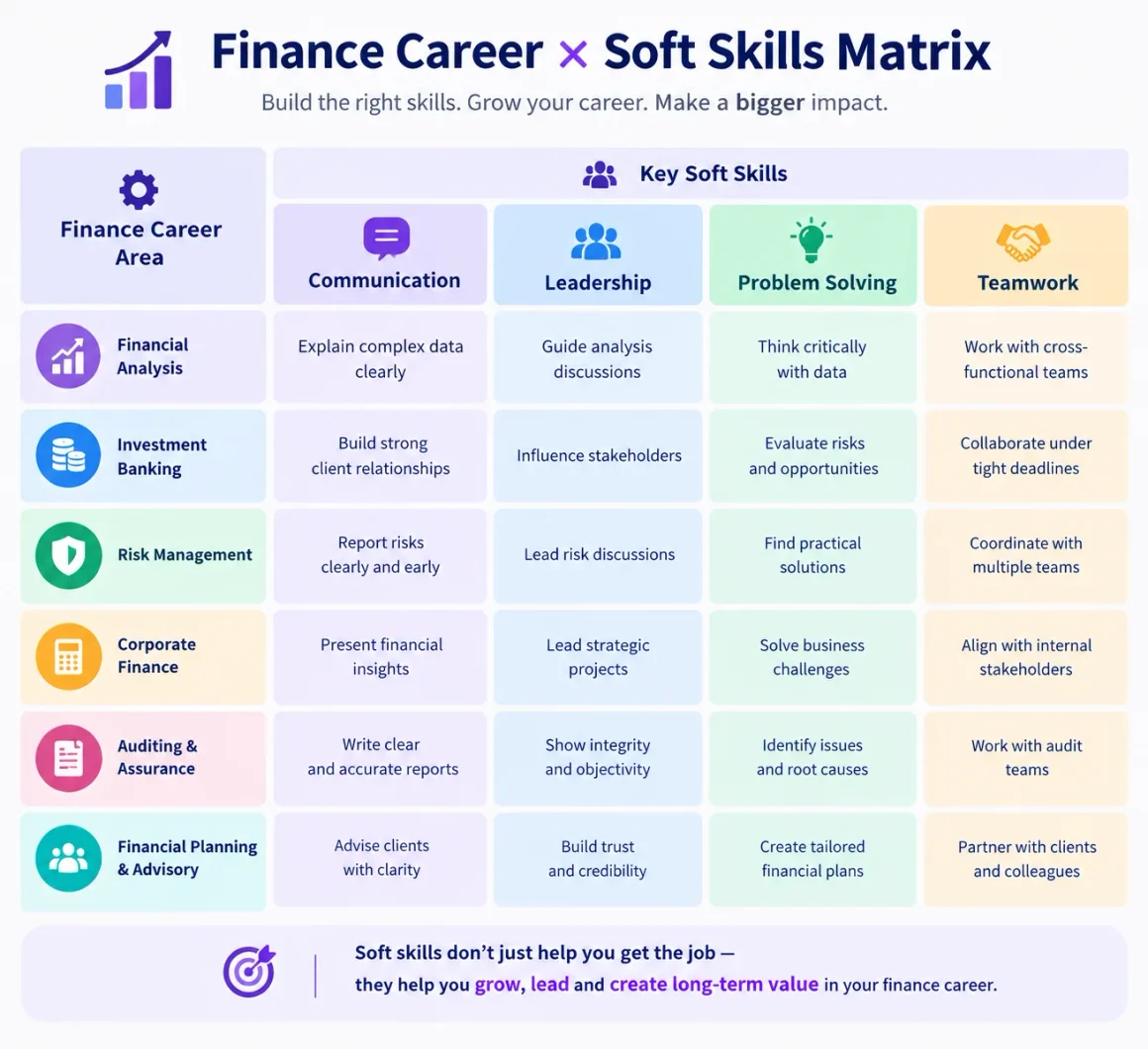
Which Soft Skills Matter for Different Finance Careers?
Not every finance career uses these skills in exactly the same way.
An investment banker and a risk analyst, for example, may both need strong communication skills—but their day-to-day situations can be very different.
Here’s a simple way to think about it.
| Finance Career | Particularly Useful Soft Skills |
|---|---|
| Investment Banking | Communication, resilience, teamwork, time management |
| Financial Analyst | Critical thinking, communication, problem-solving |
| Corporate Finance | Collaboration, decision-making, communication |
| Investment Management | Critical thinking, communication, emotional intelligence |
| Financial Consulting | Communication, problem-solving, adaptability |
| Risk Management | Critical thinking, ethical judgment, communication |
| FinTech | Adaptability, teamwork, problem-solving |
| FP&A | Financial storytelling, communication, critical thinking |
This table is an editorial guide, not a scientific ranking. The exact skills needed will depend on the employer, position, responsibilities, and seniority level.
Hard Skills vs. Soft Skills: Which Are More Important?
This doesn’t need to become a competition.
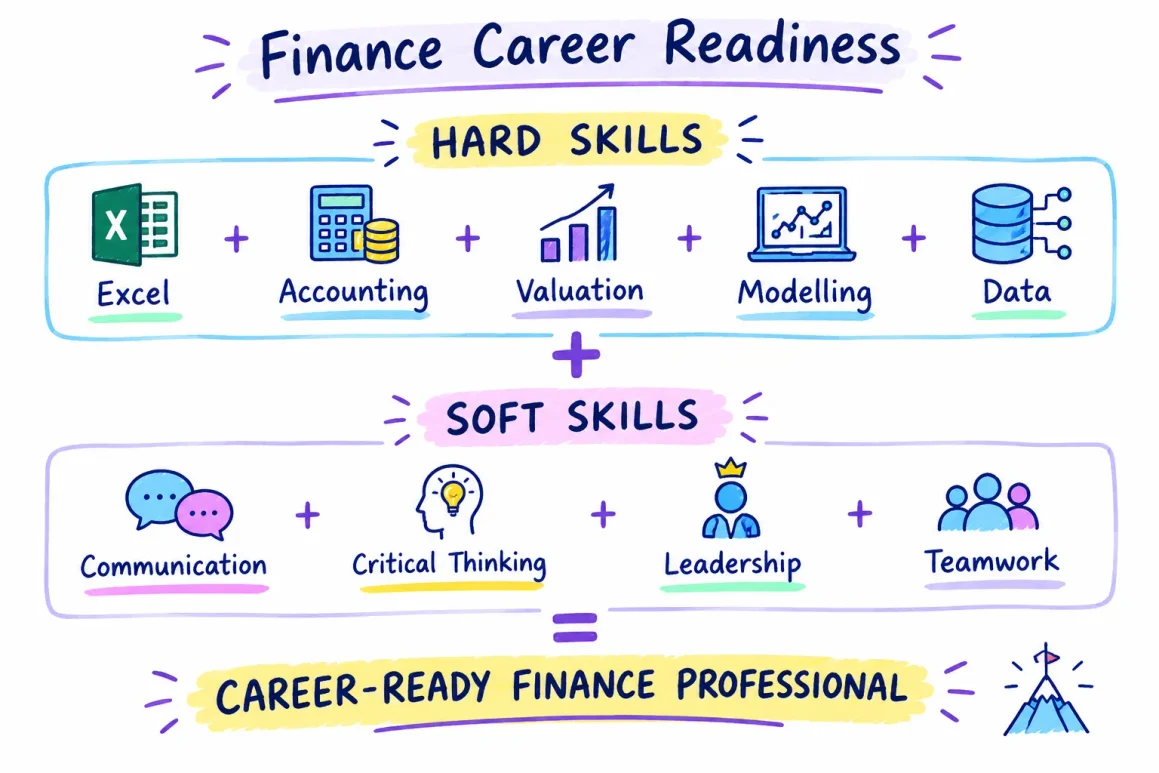
Finance professionals need both.
Imagine someone who has outstanding Excel and financial modelling skills but can’t explain their conclusions.
That’s a problem.
Now imagine someone who’s a fantastic communicator but can’t understand a balance sheet.
That’s also a problem!
A stronger combination looks like this:
Technical Knowledge + Analytical Ability + Human Skills = Career Readiness
Technical skills help you perform the work.
Soft skills help you question it, explain it, defend it, collaborate around it, and turn it into useful decisions.
How Can MBA Finance Students Improve Their Soft Skills?
Reading about soft skills won’t automatically improve them.
You need to practise them.
The good news? You don’t need an expensive course to begin.
Try this simple 30-day approach.
Week 1 — Communication
Every day, choose one financial concept and explain it in plain English.
Record yourself occasionally. Listen again. Are you clear? Are you using unnecessary jargon?
Week 2 — Critical Thinking
Read one business or finance story every day.
Identify:
What happened?
What evidence is provided?
What assumptions are being made?
What information is missing?
What might happen next?
Week 3 — Teamwork and Problem-Solving
Work through a finance case with classmates or friends.
Don’t just find an answer. Compare different solutions and explain why you’d choose one.
Week 4 — Leadership and Presentation
Choose a company.
Analyze a simple business or financial problem.
Then prepare a five-minute recommendation.
Your goal isn’t to show how many financial terms you know.
Your goal is to make your recommendation easy to understand and defend.
30-Day MBA Finance Soft Skills Challenge — Free PDF
MBA Finance Soft Skills Self-Assessment
Now it’s time for a quick check.
Be honest. This isn’t an exam!
| Soft Skill | Beginner | Developing | Confident | Strong |
|---|---|---|---|---|
| Communication | □ | □ | □ | □ |
| Critical Thinking | □ | □ | □ | □ |
| Problem-Solving | □ | □ | □ | □ |
| Financial Storytelling | □ | □ | □ | □ |
| Emotional Intelligence | □ | □ | □ | □ |
| Teamwork | □ | □ | □ | □ |
| Leadership | □ | □ | □ | □ |
| Adaptability | □ | □ | □ | □ |
| Time Management | □ | □ | □ | □ |
| Ethical Judgment | □ | □ | □ | □ |
Don’t worry if you mark several skills as “Beginner.”
That’s actually useful information.
Choose one or two weak areas and work on those first rather than trying to improve everything at once.
How to Show Soft Skills on an MBA Finance Resume
Here’s an important rule:
Don’t just claim a soft skill. Prove it.
Writing this:
“Excellent leadership skills.”
doesn’t tell an employer very much.
Instead, show what you actually did.
For example:
Weak:
Good leadership skills.
Better:
Led a five-member team during an equity valuation project and coordinated research, financial analysis, and the final presentation.
Another example:
Weak:
Excellent communication skills.
Better:
Presented financial analysis during an MBA project and translated key findings into clear recommendations for a non-finance audience.
See the difference?
The second version provides evidence.
Whenever possible, show:
Action + Context + Result
And, of course, only include examples that are genuinely true.
How to Demonstrate Soft Skills in Finance Interviews
Finance interviews aren’t always about formulas, accounting, valuation, or technical questions.
Employers may also want to know how you behave.
You might hear questions such as:
“Tell me about a time you disagreed with a teammate.”
“Describe a difficult problem you solved.”
“Tell me about a time you worked under pressure.”
“Give me an example of when you showed leadership.”
“Explain a complicated financial concept in simple language.”
A useful framework for answering experience-based questions is STAR:
S — Situation: What was happening?
T — Task: What responsibility did you have?
A — Action: What did you actually do?
R — Result: What happened because of your action?
Don’t memorize fake stories.
Instead, prepare several genuine examples from college projects, internships, competitions, volunteering, clubs, freelance work, or previous employment.
One real story can demonstrate several skills at once.
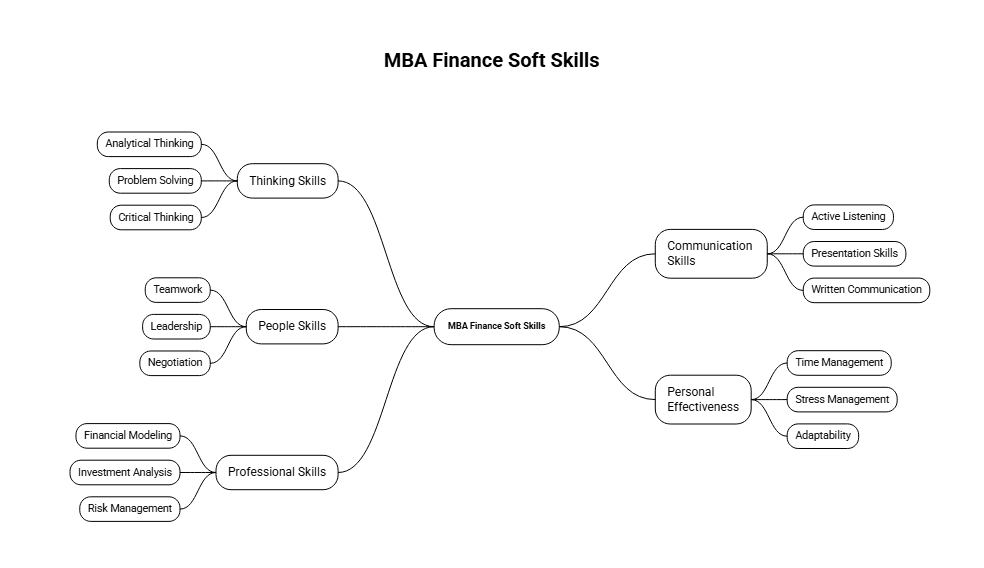
MBA Finance Soft Skills Mind Map
At this point, the ten skills can be grouped into a larger framework.
Thinking Skills
Critical Thinking
Problem-Solving
Decision-Making
Communication Skills
Business Communication
Financial Storytelling
Presentation
People Skills
Teamwork
Emotional Intelligence
Leadership
Personal Effectiveness
Adaptability
Resilience
Time Management
Professional Skills
Integrity
Ethical Judgment
Responsibility
Quick Career-Readiness Checklist
Before finishing, ask yourself these questions:
- Can I explain financial information without unnecessary jargon?
- Can I question assumptions instead of accepting every number?
- Can I solve problems systematically?
- Can I turn financial data into a meaningful story?
- Can I listen when someone disagrees with me?
- Can I work effectively with different personalities?
- Can I take responsibility without waiting for a management title?
- Can I adapt when information or circumstances change?
- Can I manage several deadlines without panicking?
- Can I make a difficult professional decision ethically?
- Can I give a real example that proves each skill?
You don’t need to answer “yes” to everything today.
The purpose of the checklist is to show you what to work on next.
Frequently Asked Questions
What are the most important soft skills for MBA Finance students?
Communication, critical thinking, problem-solving, financial storytelling, emotional intelligence, teamwork, leadership, adaptability, time management, and ethical judgment are all valuable. The exact importance of each skill depends on the finance career you’re targeting.
Why are communication skills important in finance?
Finance professionals often need to explain complicated financial information to managers, clients, investors, and colleagues who may not have the same technical knowledge. Strong communication helps turn financial analysis into information people can understand and use.
Are soft skills more important than technical finance skills?
It’s better not to treat them as competitors. Finance professionals generally need both. Technical skills help you perform analysis, while soft skills help you question, communicate, collaborate around, and apply that analysis effectively.
Can soft skills actually be learned?
Yes. Skills such as presenting, listening, teamwork, time management, and critical thinking can improve through deliberate practice, feedback, projects, internships, case studies, and real workplace experience.
How should I mention soft skills on my resume?
Show evidence instead of simply listing words such as “leadership” or “communication.” Describe a real project, responsibility, action, or result that demonstrates the skill.
How can MBA Finance students develop soft skills without work experience?
Use MBA projects, case studies, student clubs, competitions, presentations, volunteering, internships, group assignments, and independent projects. You don’t need a full-time finance job to start practising communication, teamwork, leadership, or critical thinking.
Final Thoughts
An MBA Finance student shouldn’t aim to become someone who can only calculate numbers.
Aim to become someone who can understand the numbers, question them, explain them, turn them into useful insights, make responsible decisions, and work effectively with the people behind those decisions.
Technical finance skills will always matter.
But when two candidates have similar technical knowledge, the person who communicates more clearly, thinks more critically, handles pressure better, works effectively with others, and demonstrates sound judgment may have a meaningful advantage.
And you don’t have to develop all ten skills tomorrow.
Start with one.
Look back at the self-assessment. Find your weakest area, choose one small activity, and practise it consistently for the next 30 days.
That’s a much better strategy than simply adding “excellent communication and leadership skills” to your resume!
Research & Sources
Use authoritative, original sources for the research claims in this article:
CFA Institute — Mind the Skills Gap (2026)
Research covering skills gaps and employability in the finance profession.
CFA Institute — The Future of Finance Talent: India Talent Report
Research into skills and talent requirements in India’s finance sector.
World Economic Forum — Future of Jobs Report 2025
Global employer research covering changing workforce skill requirements.
National Association of Colleges and Employers (NACE) — Career Readiness Competencies
Framework covering communication, critical thinking, teamwork, leadership, professionalism, and other career-readiness competencies.
NACE — Graduate Competency Gap Research / Job Outlook 2025
Employer research used for the competency importance and graduate proficiency comparison.