Hii, are you student or English Learner? then now you are at right place, because here i have shared something very very special for you that nowhere you will find on the internet. I have been teaching English last 8 years. Giving you pdf is not important because these days learning English has become so easy only you need to open your ChatGPT and learn speaking, listening, and practice them.
Want to understand English grammar without memorizing hundreds of confusing rules? This guide is for you.
English grammar becomes much easier when you learn how sentences work, understand common patterns, and practice them using real-life examples.
Whether you are preparing for an English exam, improving your writing, or trying to speak English confidently, having a grammar cheat sheet can save you time.
In this guide, you will learn the most useful English grammar rules with examples, including sentence structures, tenses, articles, prepositions, subject-verb agreement, and common mistakes.
You can also download our free English Grammar Rules PDF and printable Grammar Cheat Sheet for quick revision.
Download Free English Grammar Rules PDF
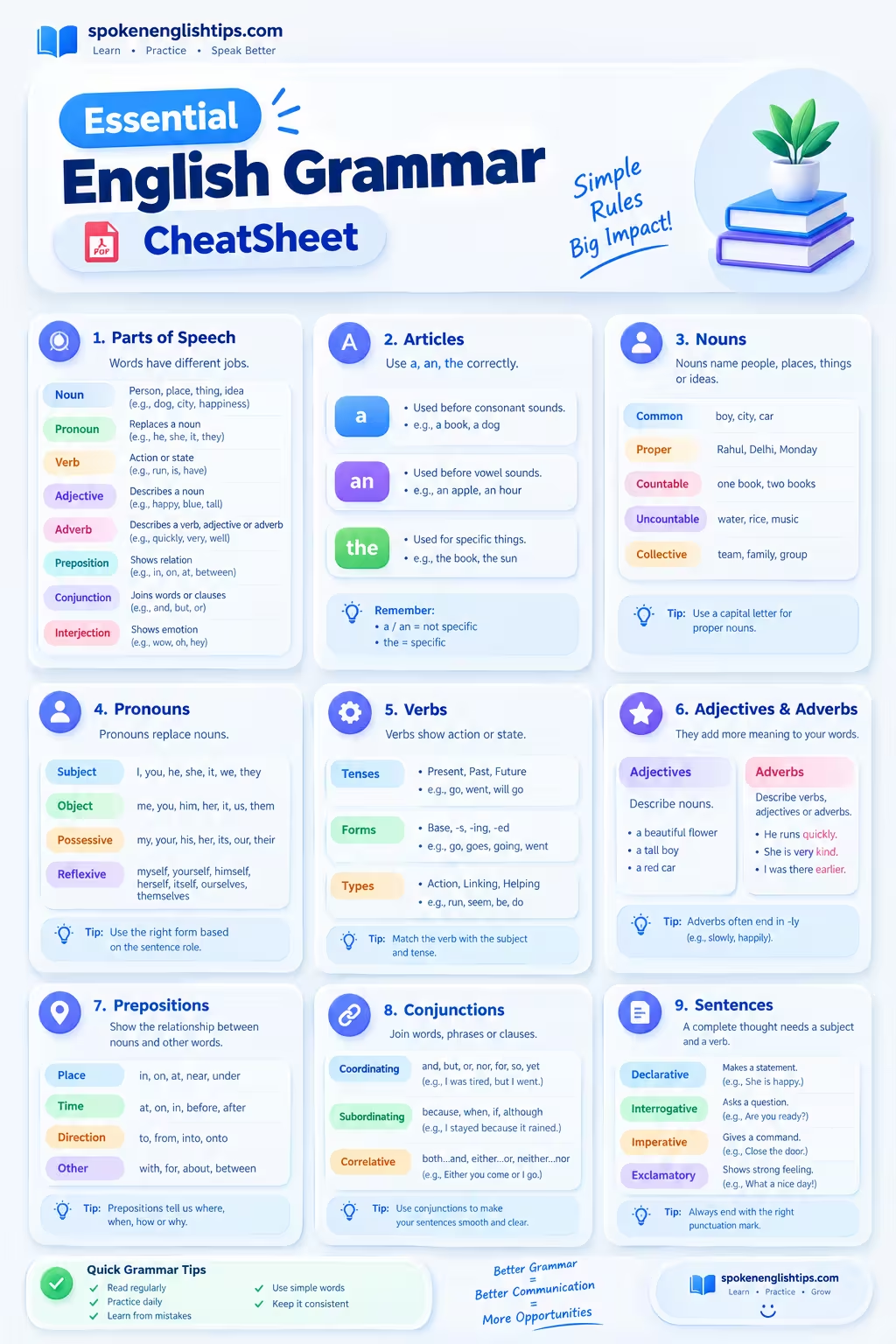
We have prepared two printable grammar resources for learners, teachers, and students.
1. English Grammar Quick Cheat Sheet PDF
This two-page printable cheat sheet is useful when you need to revise important grammar rules quickly.
It is ideal for:
- Quick grammar revision before exams
- Reviewing tense structures
- Classroom reference
- Improving everyday writing and speaking
[Download Free Grammar Cheat Sheet PDF — Insert your website download link here]
2. Complete English Grammar Rules PDF with Examples
Our 14-page grammar guide provides detailed explanations, sentence structures, example tables, practice questions, and an answer key.
Use this PDF when you want to study grammar in a more organized way.
[Download Complete English Grammar PDF — Insert your website download link here]
Both resources are available in an A4-friendly printable format.
What Is English Grammar?
English grammar is the system of rules and patterns that helps us combine words to express meaningful ideas.
Consider these two sentences:
- Incorrect: She go to school every day.
- Correct: She goes to school every day.
Both sentences are understandable, but the second follows the standard subject-verb agreement rule.
Grammar helps you communicate your meaning more clearly and naturally.
Remember: Learning grammar is not just about passing exams. It helps you ask questions, explain your experiences, write messages, and participate in conversations.
1. Understand Basic English Sentence Structure
Before learning complicated rules, start with the structure of an English sentence.
A common pattern is:
Subject + Verb + Object
| Part | Example | Function |
|---|---|---|
| Subject | Riya | Person performing the action |
| Verb | reads | Action |
| Object | a book | Receives the action |
Complete sentence: Riya reads a book.
Here are a few more sentence patterns:
| Pattern | Example |
|---|---|
| Subject + Verb | Birds fly. |
| Subject + Verb + Object | He drinks water. |
| Subject + Verb + Complement | She is happy. |
| Subject + Verb + Indirect Object + Direct Object | I gave her a pen. |
Not every sentence requires an object.
For example, “The baby sleeps” is a complete sentence.
Quick tip
When your sentence sounds confusing, first identify who or what the sentence is about and what action or state you want to describe.
2. Learn the Eight Traditional Parts of Speech
Words perform different functions in English sentences. Traditional grammar divides them into eight main categories.
| Part of speech | Function | Example |
|---|---|---|
| Noun | Names something | teacher, city, happiness |
| Pronoun | Refers to a noun or person | he, she, they |
| Verb | Expresses an action or state | run, write, seem |
| Adjective | Describes a noun | beautiful, small |
| Adverb | Modifies a verb, adjective, or adverb | slowly, very |
| Preposition | Shows a relationship | in, on, under |
| Conjunction | Connects words or clauses | and, but, because |
| Interjection | Expresses emotion | Wow! Oh! |
Example
“Wow! She completed her difficult assignment very quickly.”
In this sentence:
- Wow is an interjection.
- She is a pronoun.
- Completed is a verb.
- Difficult is an adjective.
- Assignment is a noun.
- Very and quickly are adverbs.
Understanding these functions makes it easier to form correct sentences.
3. English Tenses Rules with Examples
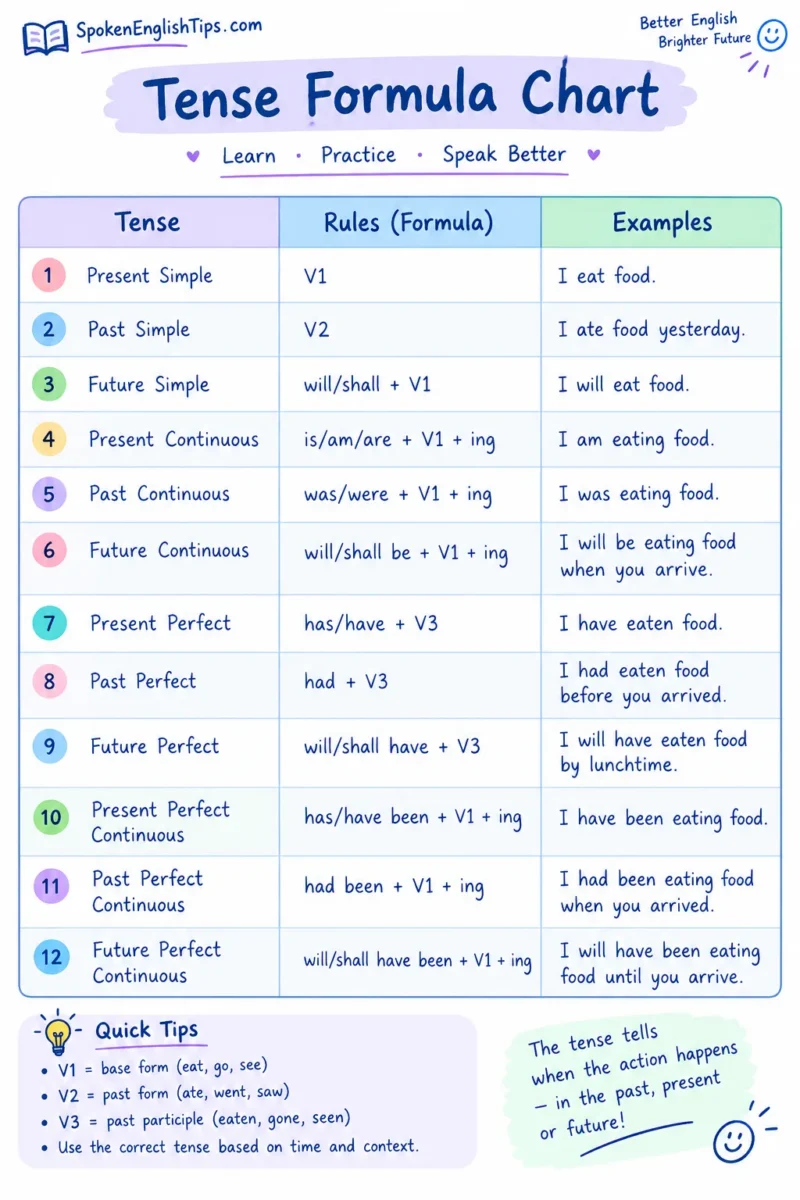
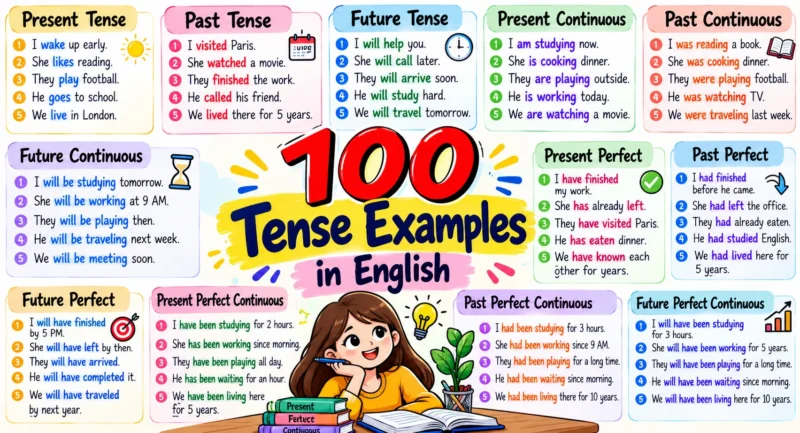
Tenses help us describe when something happens.
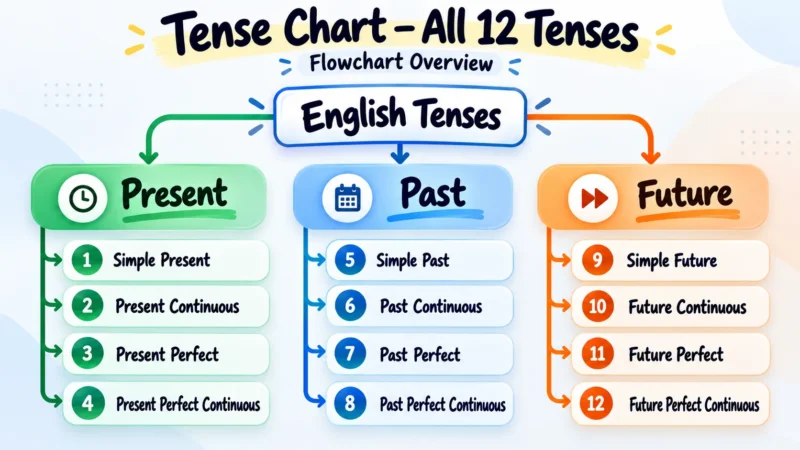
English is commonly taught using 12 tense forms, organized around the present, past, and future.
English Tenses Chart
| Tense | Structure | Example |
|---|---|---|
| Simple Present | Subject + V1 / V1+s | She works daily. |
| Present Continuous | am/is/are + V-ing | She is working now. |
| Present Perfect | have/has + V3 | She has finished her work. |
| Present Perfect Continuous | have/has been + V-ing | She has been studying for two hours. |
| Simple Past | Subject + V2 | She visited Delhi. |
| Past Continuous | was/were + V-ing | She was studying. |
| Past Perfect | had + V3 | She had left before I arrived. |
| Past Perfect Continuous | had been + V-ing | She had been working for hours. |
| Simple Future | will + V1 | She will call tomorrow. |
| Future Continuous | will be + V-ing | She will be travelling tomorrow. |
| Future Perfect | will have + V3 | She will have finished by Monday. |
| Future Perfect Continuous | will have been + V-ing | By June, she will have been working here for five years. |
V1 means the base form, V2 the simple past form, and V3 the past participle.
How to choose the correct tense
Think about the meaning before choosing a tense.
Habit: I drink tea every morning.
Action happening now: I am drinking tea.
Completed past action: I drank tea yesterday.
Past event connected to the present: I have already drunk my tea.
Future plan or prediction: I will drink tea later.
Common tense mistake
Incorrect: I am knowing the answer.
Correct: I know the answer.
The verb “know” usually expresses a state rather than an action in progress, so we normally use the simple present.
4. Articles: A, An, and The
Articles are small words, but they can completely change the meaning of a sentence.
When to use A
Use a before a singular countable noun beginning with a consonant sound.
Examples:
- a student
- a university
- a useful book
When to use An
Use an before a singular countable noun beginning with a vowel sound.
Examples:
- an apple
- an honest person
- an hour
Notice that pronunciation matters more than spelling.
We say “an hour” because the letter h is silent.
When to use The
Use the when the noun refers to something identifiable or specific.
Examples:
- Please close the door.
- The sun rises in the east.
- I found a book. The book was interesting.
Memory trick: Use “a” or “an” when introducing one unspecified countable thing, and “the” when the listener can identify which thing you mean.
5. Subject-Verb Agreement Rules
In standard English, the form of the verb often depends on the subject.
| Subject | Correct verb | Example |
|---|---|---|
| He / She / It | works | He works here. |
| I / You / We / They | work | They work here. |
| She | has | She has a car. |
| They | have | They have a car. |
| He | does | He does his homework. |
| We | do | We do our homework. |
Important rules
Rule 1: A singular third-person subject usually takes -s or -es in the simple present.
She plays football.
Rule 2: After does or doesn’t, use the base form of the main verb.
Incorrect: Does he plays cricket?
Correct: Does he play cricket?
Rule 3: Everybody, someone, and each normally take a singular verb.
Everybody is ready.
Each student has a notebook.
6. Prepositions: In, On, and At
Prepositions are often difficult because the correct word depends on the context.
Prepositions of time
| Preposition | Common use | Example |
|---|---|---|
| In | Months, years, longer periods | in December, in 2026 |
| On | Days and dates | on Friday, on 10 January |
| At | Specific clock times | at 7:30 AM |
Prepositions of place
| Preposition | Example |
|---|---|
| In | The keys are in the bag. |
| On | The phone is on the table. |
| At | She is at the entrance. |
| Under | The shoes are under the bed. |
| Between | The shop is between two banks. |
Common mistakes
Incorrect: I will meet you in Monday.
Correct: I will meet you on Monday.
Incorrect: She is good in English.
Correct: She is good at English.
Learn prepositions with complete phrases instead of memorizing individual words.
7. Modal Verbs: Can, Could, Should, Must, and May
Modal verbs express ability, possibility, permission, advice, and necessity.
| Modal | Common meaning | Example |
|---|---|---|
| Can | Ability | I can speak English. |
| Could | Polite request | Could you help me? |
| May | Permission | May I come in? |
| Might | Possibility | It might rain. |
| Should | Advice | You should practise daily. |
| Must | Strong obligation | You must wear a seat belt. |
| Would | Polite request | Would you open the window? |