Mood words, Looking forward to knowing a brief discussion about mood words. Before that Let’s have a look, What are mood words? Let’s discuss a simple definition with examples
In a simple way, Mood is an internal feeling which can be related to emotions. This appears to be the case with “mood”; many emotion theorists seem to find no special purpose for the term “mood,” using it interchangeably with other terms such as affect or emotion.
For Example, let’s understand some situations.
Mood Examples:
Condition 1: Hii, I’m so glad to have such an amazing and true person in my life. Thank you for being always there for me. May your special day bring you huge joy and true happiness. — (?Excited)
Condition 2: I know you are angry with me. there is something which I have mistaken. But whatever I am requesting from you plz… don’t behave with me like this. I know, between these days I didn’t talk to you because I was disappointed thinking about what you said. You said, there is nothing new to talk to you about. What does it mean? And also you said people have to change according to time. I was so sad to you after listening to your words but you haven’t asked, Even a single time that why are you sad. Instead of asking anything, you left me. (?Sad)
From Condition 1, It seems that the person is wishing for someone with excitement. The person’s mood is very happy. And whereas in Condition 2, the person’s mood is not happy he is feeling very bad and expresses his mood with a sad situation.
I hope you may have understood now the exact definition of mood with examples of condition1, and condition 2. Now, I gonna share with you the list of mood words.
How to pronounce mood?
Pronounce mood like Mude.
Now, moods can be of various types, and discussing mood words is very important. Generally in English speaking, we often use these mood words. So, I have listed here some words that are commonly used to describe mood: tone and mood words, words that describe mood etc.
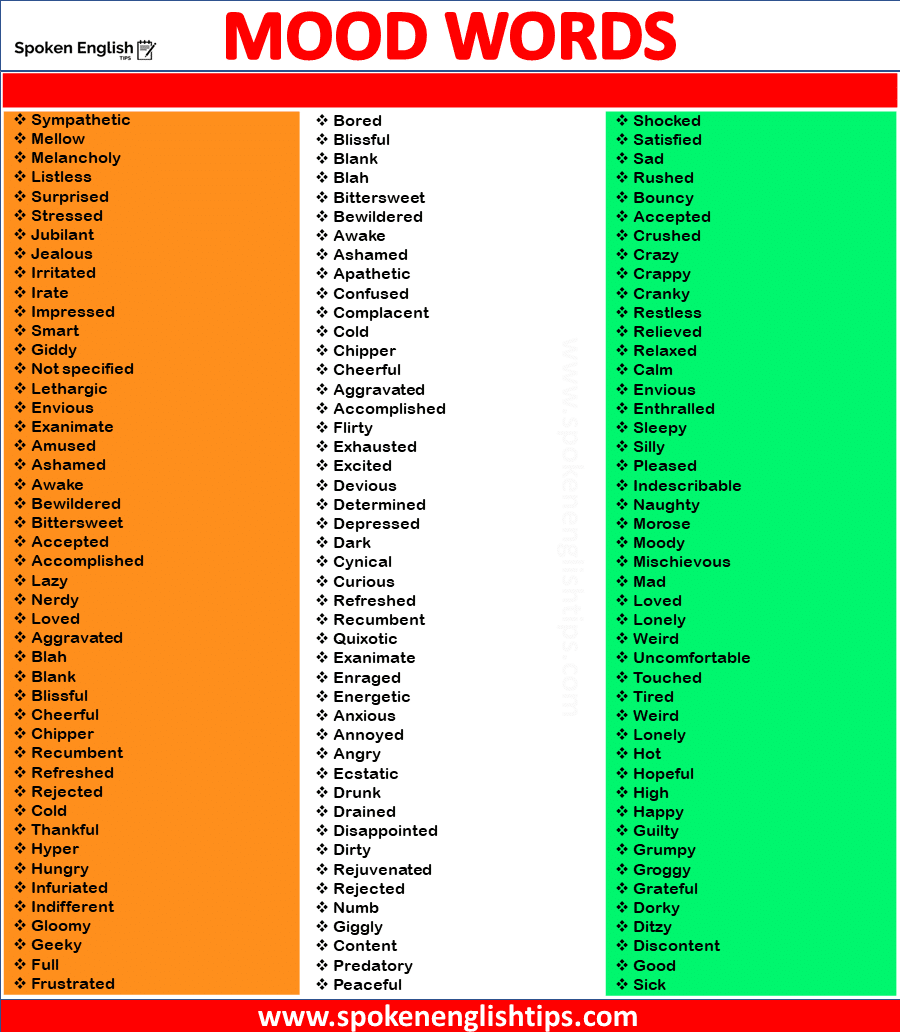
List of Mood Words
- Sympathetic
- Mellow
- Melancholy
- Listless
- Surprised
- Stressed
- Jubilant
- Jealous
- Irritated
- Irate
- Impressed
- Smart
- Giddy
- Not specified
- Lethargic
- Envious
- Exanimate
- Amused
- Ashamed
- Awake
- Bewildered
- Bittersweet
- Accepted
- Accomplished
- Lazy
- Nerdy
- Loved
- Aggravated
- Blah
- Blank
- Blissful
- Cheerful
- Chipper
- Recumbent
- Refreshed
- Rejected
- Cold
- Thankful
- Hyper
- Hungry
- Infuriated
- Indifferent
- Gloomy
- Geeky
- Full
- Frustrated
- Bored
- Blissful
- Blank
- Blah
- Bittersweet
- Bewildered
- Awake
- Ashamed
- Apathetic
- Confused
- Complacent
- Cold
- Chipper
- Cheerful
- Aggravated
- Accomplished
- Flirty
- Exhausted
- Excited
- Devious
- Determined
- Depressed
- Dark
- Cynical
- Curious
- Refreshed
- Recumbent
- Quixotic
- Exanimate
- Enraged
- Energetic
- Anxious
- Annoyed
- Angry
- Ecstatic
- Drunk
- Drained
- Disappointed
- Dirty
- Rejuvenated
- Rejected
- Numb
- Giggly
- Content
- Predatory
- Peaceful
- Optimistic
- Okay
- Alone
- Pessimistic
- Sick
- Shocked
- Satisfied
- Sad
- Rushed
- Bouncy
- Accepted
- Crushed
- Crazy
- Crappy
- Cranky
- Restless
- Relieved
- Relaxed
- Calm
- Envious
- Enthralled
- Sleepy
- Silly
- Pleased
- Indescribable
- Naughty
- Morose
- Moody
- Mischievous
- Mad
- Loved
- Lonely
- Weird
- Uncomfortable
- Touched
- Tired
- Weird
- Lonely
- Hot
- Hopeful
- High
- Happy
- Guilty
- Grumpy
- Groggy
- Grateful
- Dorky
- Ditzy
- Discontent
- Good
Read Also
FAQ (Frequently Ask Questions)
Which words in the excerpt from Mary Shelley’s introduction to Frankenstein create a dark mood?
Frankenstein created his monster. She expertly develops her tone using words and images, which is quite dark and tortured.
Which words in the passage create a dark mood?
witching hour; pale student of unhallowed arts; hideous phantasm of a man.
which group of words create mood in the passage
The group of words create mood in the passage are darker and glomy,
Conclusion
So, this is the information about ‘mood words’ to describe mood I hope you this list of moods words love this. Further, if you have any queries regarding animals’ names etc. Kindly let me know to form the comment below. Also did you like this post on Animals’ names in English?
![How to Remove Hesitation While Speaking English Step by Step If you're wondering exactly how to remove hesitation while speaking English, follow these practical steps. 1. Start Speaking Before You Feel Ready Many learners wait until their grammar becomes perfect. That day never comes. Start speaking with the English you already know. Instead of saying: "I will start speaking English after improving my vocabulary." Say: "I will improve my vocabulary by speaking English." 2. Speak in Short Sentences First Long sentences increase mental pressure. Start with simple structures: I work in sales. I live in Lucknow. I enjoy reading books. I am learning English every day. Confidence grows faster when you can complete sentences smoothly. 3. Practice Speaking Out Loud Daily Speaking silently in your mind is not enough. Read articles, stories, or conversations aloud for 10-15 minutes every day. This trains your mouth and brain to work together. [INTERNAL LINK: daily spoken English practice routine for beginners] 4. Record Yourself Speaking Most students avoid recording themselves because it feels uncomfortable. However, it is one of the fastest ways to improve. Choose a simple topic: My job My hometown My daily routine My future goals Record for one minute and listen carefully. You will quickly identify: Frequent pauses Pronunciation issues Repeated words 5. Think in English Instead of translating, start creating simple thoughts directly in English. For example: While drinking tea, think: This tea is hot. I need to finish my work. The weather is pleasant today. Small habits create big improvements. Stop Translating in Your Head One major reason behind hesitation is mental translation. Why Translation Creates Delays Imagine someone asks: "What did you do yesterday?" If your brain follows this path: Hindi → English Translation → Grammar Check → Speak You will hesitate. Instead, train yourself to answer directly: "I visited my friend." "I watched a movie." "I completed a project." A Simple Exercise For 5 minutes daily: Look around your room and describe objects in English. Examples: The fan is running. My laptop is on the table. I need to clean this shelf. This helps your brain create English thoughts naturally. [INTERNAL LINK: how to think in English without translating] Build Speaking Confidence With Daily Practice Confidence does not come before speaking. Confidence comes from speaking repeatedly. Student Story #1 One of my students, a software engineer from Pune, understood English very well but hesitated badly during meetings. Whenever someone asked a question, he would spend several seconds forming the perfect answer. I encouraged him to focus on communicating rather than being perfect. Within six weeks of daily speaking practice, his hesitation reduced dramatically and he became much more active in discussions. Student Story #2 I remember teaching a customer support executive who constantly said "umm..." and "actually..." before every sentence. We practiced one-minute speaking exercises every day for a month. By replacing filler words with brief pauses and improving speaking confidence, she started speaking much more naturally during client calls. In my experience teaching hundreds of Indian learners, hesitation decreases fastest when students practice speaking consistently rather than studying grammar for hours. Common Mistakes That Increase Hesitation Many learners unknowingly make these mistakes. Mistake Result Translating every sentence Slow speech Trying to sound perfect Increased anxiety Memorizing without speaking Low confidence Fear of mistakes Longer pauses Comparing yourself to fluent speakers Reduced motivation Avoiding conversations No real improvement Avoiding these habits can significantly improve your fluency. Useful English Phrases When You Get Stuck Even fluent speakers sometimes need a moment to think. Instead of becoming silent, use these phrases. When You Need Time to Think That's an interesting question. Let me think for a moment. As far as I know... From my experience... When You Don't Understand Instead of saying: "What?" Say: Could you please repeat that? Sorry, I didn't catch that. Could you say that again? When You Forget a Word Try: I'm not sure of the exact word, but... What I mean is... Let me explain differently. These phrases help maintain the flow of conversation. [INTERNAL LINK: useful English phrases for daily conversation] 15 Practical Tips to Remove Hesitation Quickly Here are some practical strategies you can start today: Speak English for at least 15 minutes daily. Stop waiting for perfect grammar. Think in English during routine activities. Record your voice regularly. Read aloud every day. Learn useful speaking phrases. Join English conversation groups. Talk to yourself in English. Practice answering common interview questions. Focus on communication, not perfection. Improve pronunciation gradually. Watch English content actively. Shadow native speakers. Celebrate small improvements. Speak even when you feel nervous. The goal is progress, not perfection. A Simple 15-Minute Daily Routine to Reduce Hesitation If you're busy, follow this routine. Minutes 1-5: Read Aloud Choose any English article or story. Focus on: Clear pronunciation Natural pace Confidence Minutes 6-10: Speak on a Topic Choose one topic: My family My career My favorite movie My goals Speak continuously. Do not stop for mistakes. Minutes 11-15: Think and Describe Describe: Your room Your surroundings Your plans Only in English. Do this consistently for 30 days and you will notice a visible reduction in hesitation. [INTERNAL LINK: best daily English speaking exercises at home] What to Do During Interviews or Meetings Many learners hesitate most during professional situations. Try these strategies: Slow Down Slightly Speaking slowly is better than speaking nervously. A calm pace sounds more confident. Focus on the Message Your goal is communication, not perfection. Interviewers care more about clarity than flawless grammar. Use Familiar Vocabulary Don't force difficult words. Simple English spoken confidently creates a stronger impression. Example: Instead of: "I possess exceptional interpersonal communication capabilities." Say: "I communicate well with people and enjoy teamwork." The second version sounds more natural and confident. How Long Does It Take to Remove Hesitation? The answer depends on your current level and practice consistency. Most learners notice improvement within: 2-4 weeks of daily practice 2-3 months of regular speaking 6 months of consistent conversation practice In over 8 years of teaching spoken English, I've noticed that students who speak daily improve much faster than students who only study grammar and vocabulary. Consistency beats intensity every time. Conclusion Learning how to remove hesitation while speaking English is not about becoming perfect overnight. It is about speaking regularly, making peace with mistakes, and training yourself to think and respond in English naturally. Start with just 15 minutes of daily speaking practice. Over time, your confidence will grow, your pauses will reduce, and speaking English will begin to feel much more natural. If you try any of the techniques from this article, share your experience in the comments and let us know what helped you most. Frequently Asked Questions Can hesitation while speaking English be completely removed? Yes, hesitation can be reduced significantly through regular speaking practice, confidence-building exercises, and thinking in English instead of translating. Even fluent speakers pause occasionally, but frequent hesitation can be overcome with consistency. Why do I hesitate even when I know English? This usually happens because of fear of mistakes, overthinking grammar, lack of speaking practice, or translating from your native language before speaking. How can I remove hesitation while speaking English at home? Practice reading aloud, record yourself speaking, talk to yourself in English, and describe daily activities in English. Just 15 minutes a day can make a noticeable difference. Does grammar cause hesitation? Sometimes, but not always. More often, hesitation comes from fear of making grammar mistakes rather than actual grammar weakness. How long does it take to speak English confidently? Many learners notice improvement within a few weeks of daily practice. Significant confidence usually develops over a few months of regular speaking. Is it okay to make mistakes while speaking English? Absolutely. Mistakes are a natural part of learning. Every fluent speaker made countless mistakes before becoming confident. FAQ Schema-ready Q&A Pairs Question: Can hesitation while speaking English be completely removed? Answer: Yes, hesitation can be reduced significantly through regular speaking practice, confidence-building exercises, and thinking in English instead of translating. Consistent practice helps develop fluency and confidence over time. Question: Why do I hesitate even when I know English? Answer: Most learners hesitate because of fear of making mistakes, overthinking grammar, lack of speaking practice, or translating from their native language before speaking. Question: How can I remove hesitation while speaking English at home? Answer: Practice reading aloud, record your voice, talk to yourself in English, and describe your surroundings in English daily. These exercises help build fluency and confidence. Question: Does grammar cause hesitation while speaking English? Answer: Grammar can contribute to hesitation, but fear of making grammar mistakes is often a bigger issue. Focusing on communication rather than perfection helps reduce hesitation. Question: How long does it take to speak English confidently? Answer: Many learners see improvement within 2-4 weeks of consistent practice. Strong confidence and fluency typically develop over several months of regular speaking. Question: Is it okay to make mistakes while speaking English? Answer: Yes. Making mistakes is a normal part of language learning. Every fluent speaker makes mistakes while learning, and speaking regularly is more important than speaking perfectly.](https://spokenenglishtips.com/wp-content/uploads/2026/06/How-to-Remove-Hesitation-While-Speaking-English-Step-by-Step-800x533.webp)


We stumbled over here coming from a different page and thought I may as well check things out. I like what I see so i am just following you. Look forward to checking out your web page again.
Thanks